
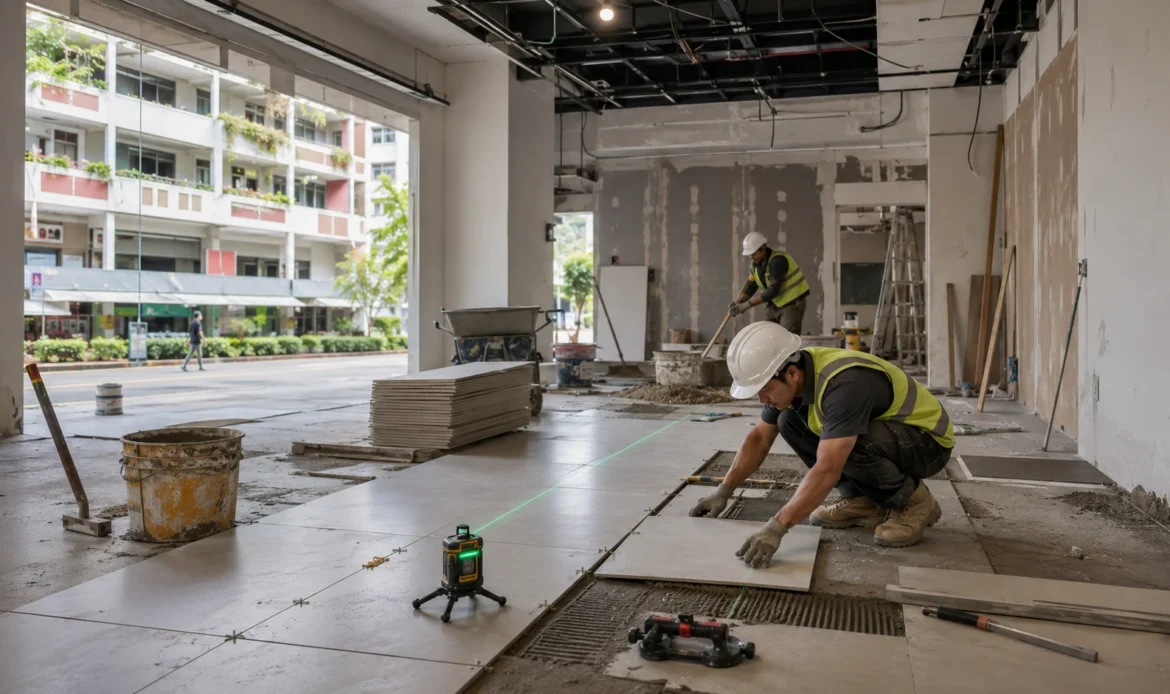
Quick Summary: Under Singapore’s Housing & Development (Renovation Control) Rules 2006, every renovation in an HDB unit, including commercial shophouses and retail spaces, must be carried out by a contractor listed in HDB’s Directory of Renovation Contractors (DRC). Non-compliance can result in fines of up to S$5,000, mandatory reinstatement orders, and the cancellation of business insurance. This guide explains exactly what is at stake and how to protect your commercial investment.
I. The High Stakes of HDB Commercial Renovation: Why Tiling Is Never "Just Tiling"
If you run a business in an HDB commercial unit, whether it is a kopitiam in Toa Payoh, a retail shop in Bedok, or a beauty salon tucked beneath a Bishan residential block, you already know that renovating your space is a critical investment. A fresh floor can transform the look of your outlet, attract more footfall, and signal to customers that you mean business.
What many business owners do not realise is that their commercial unit often sits directly beneath a residential block housing hundreds of families. The floor slab underneath your tiles is not just your floor; it is someone else’s ceiling. One poorly executed tiling job, one wrong screed mix, one ignored waterproofing step, and you could be personally liable for water damage, structural cracking, and costly neighbour complaints that drag on for months.
This is why the law does not leave it to chance.
Under the Housing & Development (Renovation Control) Rules 2006, all renovation works within HDB commercial units, including tiling, hacking, screed laying, and waterproofing, must be performed exclusively by contractors listed in HDB’s Directory of Renovation Contractors (DRC). This is not a recommendation. It is a statutory requirement. And hiring an unlicensed contractor to save a few hundred dollars could end up costing you tens of thousands.
If you are planning a commercial renovation in an HDB building, this guide is your essential compliance handbook.
II. The Legal and Financial Risks of Non-Compliance

Let us be clear about what happens when business owners skip the licensing requirement.
Fines of Up to S$5,000 Per Violation
Engaging an unlicensed contractor violates the Housing & Development Act and the Renovation Control Rules. HDB enforcement is active, and penalties are real. Fines of up to S$5,000 can be imposed, and that is before you factor in the reinstatement costs.
Mandatory Reinstatement Orders
If unauthorised works are detected, HDB has the authority to issue a reinstatement order, requiring you to undo all the completed works and restore the unit to its original condition. You bear this cost entirely, even if the tiling looks perfectly fine. This means paying twice: once for the unlicensed job and again for the licensed contractor to redo it properly.
Permit Access Is Restricted to Licensed Contractors Only
Here is a practical hurdle that many business owners overlook: only HDB-registered contractors can access the APEX (Application for Renovation Permit via Electronic Transaction) system to submit a Notice of Alteration (NOA) for hacking and tiling works. If your contractor is not on the DRC list, they cannot file the permit. Full stop. That means every subsequent step of your renovation is technically illegal from day one.
Voided Business and Property Insurance
This is perhaps the most financially dangerous consequence. Most commercial property insurance policies contain a clause that voids coverage for any damage arising from unauthorised renovation works. If an unlicensed tiling job causes water seepage into the unit below, cracks in the shared slab, or damage to a neighbour’s shopfront, you, the unit owner, become personally liable for all third-party claims. A single water damage claim in a Singapore commercial building can easily run into S$20,000 to S$50,000 or more.
💡 Not sure if your current renovation quote is from an HDB-registered contractor? WhatsApp Leong Yik Engineering today for a free compliance check before you commit.
III. Strict Engineering Constraints: The 50mm Rule and Dead Load Limits
Commercial renovation professionals often encounter business owners who have been told by cheaper, unlicensed operators that “tiles are just tiles.” The engineering reality tells a very different story.
The Load Limit You Cannot Ignore
HDB floor slabs are designed to carry specific permanent loads (known as “dead loads” or “Permanent Actions” in structural engineering). For floor finishes in HDB commercial units, the additional load after removal of existing floor screed must not exceed 1.2 kN/m². This is an official HDB technical requirement.
Exceeding this load through excessively thick screed, heavy stone tiles, or multiple-layered finishes compromises the structural integrity of the slab. In a building above shared by hundreds of residents, that is not a technical footnote. It is a public safety matter.
The Non-Negotiable 50mm Thickness Rule
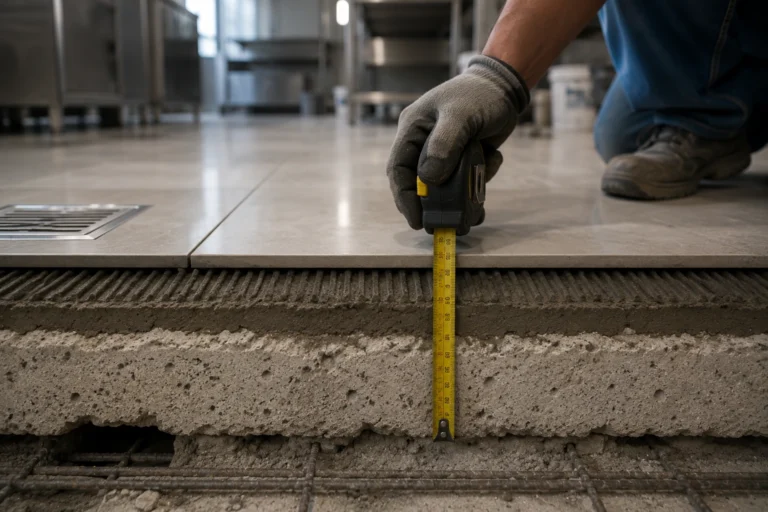
One of the most critical and frequently violated rules in HDB tiling is the 50mm thickness cap. The combined total thickness of your new floor tiles and the underlying cement screed layer must not exceed 50mm. This applies to HDB commercial units, residential flats, and all property types within HDB buildings.
Going beyond 50mm is not just a regulatory violation. It overloads the floor slab, prevents proper door clearance, creates tripping hazards, and can cause the tiles to crack or become hollow within months.
A licensed contractor knows this rule by heart and will plan your screed depth and tile selection accordingly. An unlicensed operator likely will not.
Why Pre-Packed Screed Is Mandatory
Since June 2015, HDB has mandated the use of pre-packed screed, rather than site-mixed sand and cement, for laying floor finishes in dry areas. This regulation exists for a very good reason.
Site-mixed screed is inconsistent. Variable ratios of cement and sand mean variable compressive strength. Weak spots in the screed lead to hollow tiles, surface cracks, and costly rework within 2 to 3 years of installation. Pre-packed, factory-blended screed delivers consistent compressive strength and bonding performance, protecting your investment for the long term.
Licensed contractors such as Leong Yik Engineering & Contractor Pte. Ltd. use only HDB-approved pre-packed screed products that meet the performance standards set out in HDB’s Material List, ensuring your floor is structurally sound from the ground up.
IV. Protecting the Building Stack: Waterproofing and Wet Areas
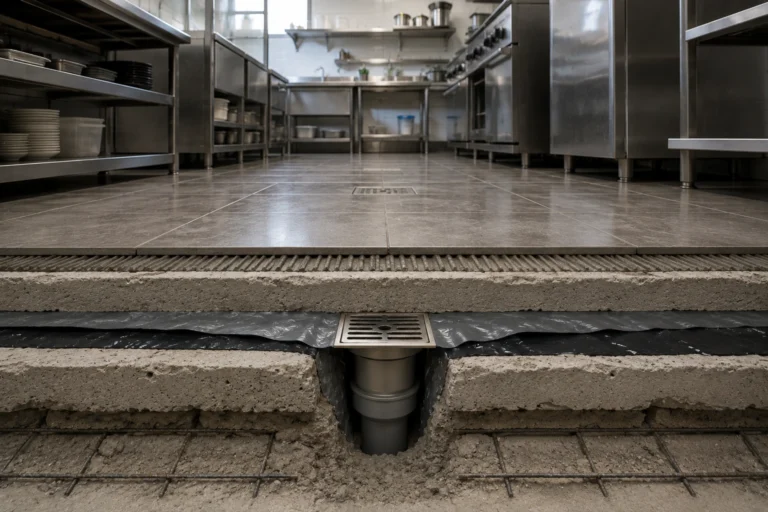
For commercial kitchens, food stalls, toilets, and wet preparation areas, which are extremely common in HDB commercial units, waterproofing is not optional. It is a mandatory, regulated process.
The 3-Year BTO Hacking Ban
For newly completed Build-To-Order (BTO) units, including newly allocated HDB commercial spaces, there is a mandatory three-year restriction on hacking existing bathroom or wet area floor tiles. This restriction is in place to protect the original waterproofing membrane installed by HDB. Disturbing this membrane prematurely can void your HDB waterproofing warranty and cause water seepage to the units below.
During this restriction window, the only compliant approach is to overlay new tiles using approved adhesive methods: no hacking, no screed replacement. A licensed contractor knows when an overlay is permissible and how to execute it correctly.
Waterproofing Protocols for Commercial Kitchens and Toilets
Once the restriction period passes, or for older commercial units undergoing full renovations, licensed contractors must follow HDB’s waterproofing protocol precisely:
- Apply a pre-packed waterproofing screed as the base layer in all wet areas.
- Install an HDB-approved waterproofing membrane.
- Turn up the membrane at least 150mm against all surrounding walls and kerbs to create a watertight seal.
- Ensure full coverage around all floor traps, pipe penetrations, and drain points.
These steps are not procedural niceties. They are the physical barriers between your commercial kitchen floor and your downstairs neighbour’s ceiling. Skipping any one of them creates a direct pathway for water ingress.
Mandatory Water Test Upon Completion
Here is something that surprises many business owners: after completing any tiling work in a wet area, a mandatory water test must be conducted to verify the unit is fully watertight before the renovation is officially closed. This water test is documented and included in the permit completion record.
Only a licensed contractor who filed the permit can close out this process officially with HDB. Unlicensed works have no such accountability. If a leak appears three months after your contractor has disappeared, you are on your own
Leong Yik Engineering performs full waterproofing and water testing as part of every commercial tiling project. Request a detailed scope of work here.
V. Community Impact: Noise Rules and Working Hour Compliance
Running a business in an HDB estate means operating as part of a community. Your renovation affects your neighbours, including the commercial tenants on the same floor and the residential families in the units above. HDB has strict rules governing when and how renovation noise is permitted, and your licensed contractor is legally responsible for complying.
Restricted Hours for Noisy Works
Tiling renovations almost always involve hacking (removing existing tiles), cutting (trimming new tiles), and drilling, all of which are classified as noisy works under HDB regulations. These activities are only permitted:
- Monday to Friday, 9:00 AM to 5:00 PM (for noisy works such as hacking, tile cutting, and heavy drilling)
- Monday to Saturday, 9:00 AM to 6:00 PM (for general renovation works)
- Strictly prohibited on Sundays, Public Holidays, and the eves of major holidays
Any licensed contractor worth engaging will schedule your project timeline around these windows. If a contractor offers to do weekend hacking to “save time,” that is a serious red flag and a violation that can result in complaints, stop-work orders, and fines.
The Two Power Tools Rule and Three-Day Hacking Limit
HDB regulations also limit the amount of noise that can be generated at any one time. Renovation contractors are permitted to use no more than two handheld power tools simultaneously. Furthermore, all hacking and removal of floor or wall finishes must be completed within three consecutive days. These rules exist to ensure that the disruption to the surrounding community is time-limited and manageable.
Licensed contractors plan their workflow to meet these constraints. Unlicensed operators typically do not.
Neighbour Notification Requirements
Before commencing renovation works, contractors must serve a written notice to neighbours within a two-unit radius at least five working days in advance. This is more than courtesy: it is an HDB requirement. Licensed contractors manage this process as part of their permit obligations. When using an unlicensed contractor, this step is almost always skipped, which often leads to neighbour complaints, HDB investigations, and project shutdowns.
VI. Financial Safeguards: Insurance and CaseTrust Protection
Beyond regulatory compliance, hiring a licensed contractor provides significant financial protection that unlicensed operators simply cannot offer.
Contractor's All Risks (CAR) Insurance
Licensed renovation contractors are required to hold Contractor’s All Risks (CAR) insurance, which typically includes third-party liability coverage. This insurance protects you, the unit owner, if renovation activities cause damage to neighbouring properties. Coverage amounts typically range from S$50,000 to S$500,000 or more, depending on the project scope.
Without this coverage, any structural cracks, water damage, or injury to third parties during your renovation becomes your personal liability. CAR insurance is one of the key documents you should always request from your contractor before work begins.
CaseTrust Accreditation: Protection for Your Deposit
Many of Singapore’s top HDB-licensed renovation contractors are also CaseTrust-accredited, a certification administered by the Consumers Association of Singapore (CASE). CaseTrust-accredited contractors offer deposit performance bonds, which protect your renovation deposit if the contractor fails to complete the works or ceases operations mid-project.
Given that most renovation projects require an upfront payment, this protection matters. In 2024 alone, the Consumers Association of Singapore (CASE) received over 1,300 renovation-related complaints, many involving unlicensed or unreliable contractors who disappeared after collecting deposits.
Leong Yik Engineering & Contractor Pte. Ltd. operates with full transparency on insurance and compliance documentation. We provide proof of coverage before any works commence, because that is what a professional contractor does.
VII. How Leong Yik Engineering Handles Commercial Tiling: End-to-End
As an HDB-licensed renovation contractor, BCA-registered contractor (multiple workheads), and BizSafe Star certified firm, Leong Yik Engineering & Contractor Pte. Ltd. brings over seven years of commercial and residential renovation expertise to every tiling project we undertake.
When you engage us for a commercial tiling project in an HDB unit, here is what you can expect:
Pre-Works Phase
- Site assessment and compliance review against current HDB guidelines
- Permit application via APEX on your behalf, including Notice of Alteration (NOA) for all hacking and tiling works.
- Neighbour notification management
During Works
- Strict adherence to HDB noise control schedules (9 AM – 5 PM, weekdays only for noisy works)
- Use of HDB-approved pre-packed screed only: no site mixing
- Full compliance with the 50mm thickness limit
- Waterproofing membrane installation with mandatory 150mm upturns in wet areas
- Documentation of all stages for permit compliance
Post-Works
- Mandatory water test for all wet area tiling
- Photographic documentation of completed works
- Permit closure with HDB.
We hold ISO 9001:2015 (Quality Management), ISO 45001:2018 (Occupational Health & Safety), and ISO 14001:2015 (Environmental Management) certifications, reflecting our commitment to structured, safe, and responsible construction practices on every project.
💡Planning a commercial renovation in an HDB building? Talk to our team today.WhatsApp us at +6594483512 or fill in our enquiry form for a no-obligation site assessment.
VIII. HDB Commercial Tiling: Frequently Asked Questions
Q1: Do HDB commercial unit renovations fall under the same rules as residential flats?
Yes. HDB commercial units, such as shops, offices, and food establishments in HDB estates, are subject to the Housing & Development (Renovation Control) Rules in the same way as residential flats are. All renovation works must be carried out by contractors listed in the HDB Directory of Renovation Contractors (DRC), and permits must be obtained for all regulated works, including tiling, hacking, and waterproofing.
Q2: How much does a licensed commercial tiling job typically cost in Singapore?
Commercial tiling costs vary depending on tile material, floor area, the condition of the slab, and the scope of required waterproofing works. For HDB commercial units, expect professional screed and tile installation (including materials and labour) to range from approximately S$8 to S$18 per square foot, depending on tile grade and complexity. Waterproofing for wet areas like kitchens and toilets typically adds S$3 to S$6 per square foot. Always request an itemised quotation.
Q3: How long does an HDB tiling permit take to get approved?
HDB renovation permit approvals typically take up to three weeks from submission, though simpler applications without structural changes may be approved in three to seven working days. Your contractor submits the application through the APEX system. Factor this timeline into your project planning: no physical work can begin until the permit is granted.
Q4: Can I overlay new tiles on top of existing ones to avoid hacking?
In some cases, yes. Overlaying new tiles over existing ones using adhesive is permitted, subject to conditions. Only one existing layer of floor finishes may be present; the combined total thickness (including adhesive and new tiles) must not exceed 13mm for overlay methods, and the work must not interfere with floor traps or cause lateral water seepage. This approach is particularly relevant during the BTO restriction period for wet areas. Your contractor should assess the existing floor condition before recommending an overlay or replacement.
Q5: What happens if my tiling contractor is found to be unlicensed mid-project?
HDB can issue an immediate stop-work order, and all incomplete work must halt. You will be required to engage a licensed contractor to either complete or reinstate the works, at your own expense. Any permit that has not been filed will be treated as unauthorised works. This scenario is far more expensive and disruptive than hiring a licensed contractor from the start.
Q6: How do I verify that my contractor is on the HDB DRC list?
Visit https://services2.hdb.gov.sg and search for the contractor’s company name in the Directory of Renovation Contractors. Confirm that the licence status shows “Active” and that the registration dates are current. Never rely solely on certificates or documents provided by the contractor. Always verify independently through the official HDB portal.
IX. Conclusion: Your Commercial Space Deserves a Licensed Professional
Commercial renovation in an HDB building is not a do-it-yourself project, and it is not a place to cut corners with an unlicensed operator offering a lower price. The regulations exist for good reason: to protect the structural integrity of shared buildings, safeguard the community, and ensure that business owners and their neighbours are not left with costly consequences from poorly executed works.
Hiring an HDB-licensed contractor for your commercial tiling project protects you on every front: legally, financially, and structurally. It ensures your renovation is valid, your insurance remains intact, and your floor will last for years without cracking, leaking, or failing.
Leong Yik Engineering & Contractor Pte. Ltd. is your trusted partner for compliant, high-quality commercial tiling works in Singapore. As an HDB-licensed contractor, BCA-registered firm, and BizSafe Star-certified organisation, we manage your entire renovation journey, from permit to punch list, so you can focus on running your business.
📞 Ready to Start Your Commercial Renovation the Right Way?
Contact Leong Yik Engineering & Contractor Pte. Ltd. today:
- 🟢 WhatsApp: +6594483512
- 🟢 Call: +6566932359
- 📧 Email: enquiry@leongyik.com.sg
- 🌐 Website: www.leongyik.com.sg
- 📍 Singapore-based | HDB Licensed | BCA Registered | BizSafe Star
Get a free, no-obligation site assessment and itemised quotation. Our team responds within 12 hours.