
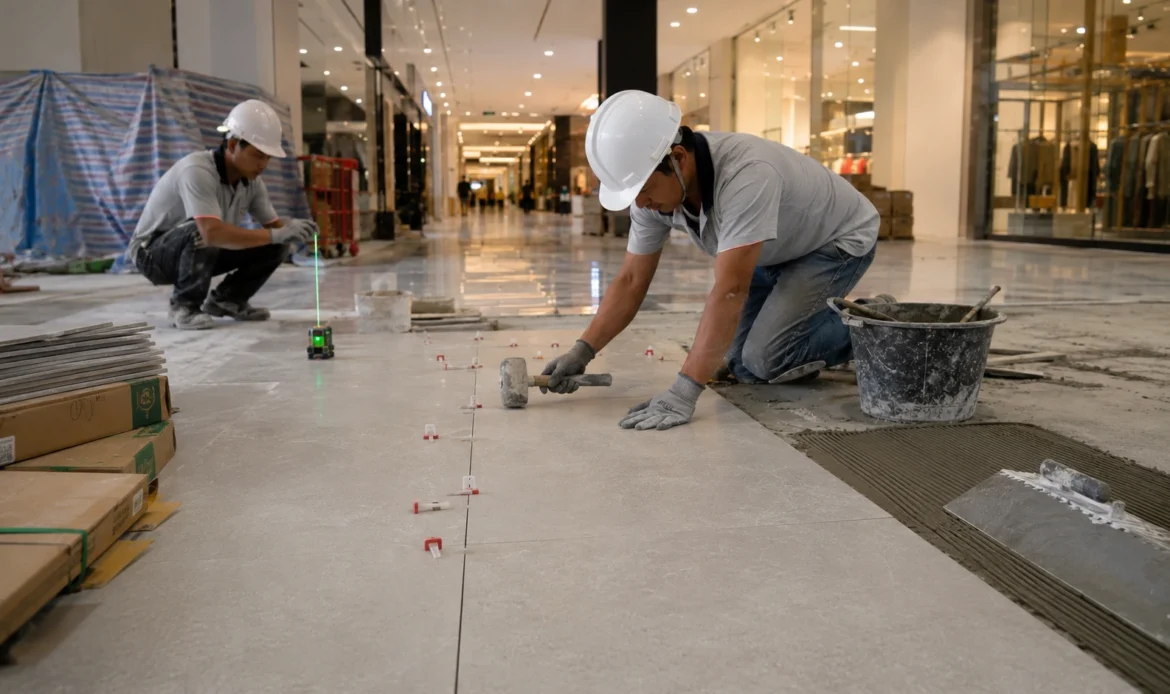
Specifying the wrong floor for a busy Singapore commercial space is an expensive mistake. Choose a surface that cannot take the daily punishment of luggage trolleys, stiletto heels and nightly scrubber machines, and you are looking at premature wear, slip-and-fall liability, and a re-tiling bill that arrives years too early. So when developers, facilities managers and designers weigh up homogeneous vs. porcelain floor tiles, the stakes are genuinely high and the budget is rarely small.
There is just one problem with that comparison, and almost every article online gets it wrong.
This guide sets it straight. You will learn what actually separates these two options, which one survives heavy footfall, rolling loads and industrial cleaning, how Singapore’s slip-safety rules apply to your project, what the floor really costs over its lifetime, and a simple “use this here” framework you can apply to your own building.
The Comparison Isn't What You Think: Homogeneous Is Porcelain
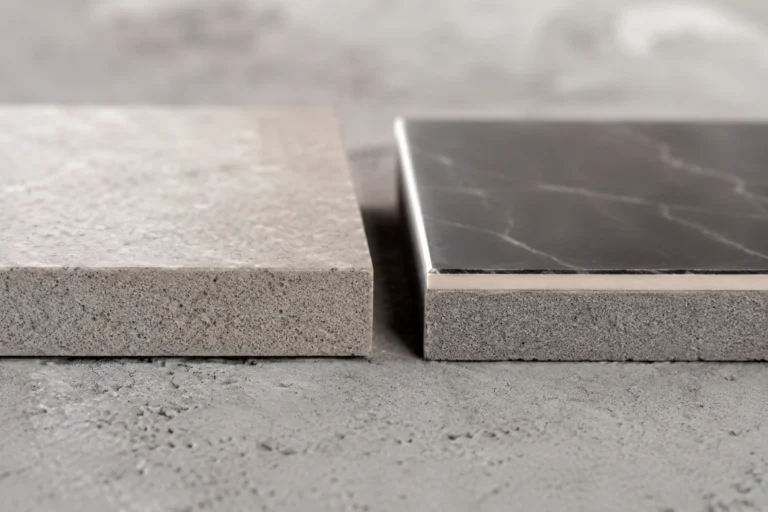
Here is the detail that changes how you should read every “homogeneous vs porcelain” debate. A homogeneous tile is not an alternative to porcelain. It is porcelain, specifically a full-body (also called through-body) porcelain tile, where the colour and material run uniformly from the surface all the way to the base. Singapore tile suppliers and manufacturers consistently classify homogeneous tile as a member of the porcelain family, not a rival to it.
So the question that experienced specifiers are really asking is this: full-body (homogeneous) porcelain versus glazed porcelain, which is better for heavy commercial traffic? Framed that way, the decision becomes far clearer.
Common misconception: Homogeneous is not a different material from porcelain. It is a type of porcelain, defined by how it is built (colour throughout the body) rather than by being a separate product category.
What "Homogeneous" Actually Means
“Homogeneous” describes construction, not a separate class of tile. The colour and pattern are mixed through the entire body before the tile is pressed, so there is no separate decorative “skin” sitting on top. That is why you will also hear these tiles called full-body or through-body tiles. Cut one in half and the core looks essentially the same as the surface.
The takeaway is simple. When a datasheet says “homogeneous,” it is telling you about the tile’s internal make-up, uniform all the way through, not that it sits in some category outside porcelain.
What "Porcelain" Actually Means
Porcelain is defined by how dense and water-resistant it is. It is made from refined clays fired at high temperatures until the body vitrifies, effectively turning glassy and non-porous. The internationally recognised threshold, set out in ISO 10545-3 on water absorption, is a water absorption rate of 0.5 percent or less, which classifies the tile as “impervious.”
That imperviousness is exactly why porcelain outperforms ordinary ceramic in demanding settings. It resists stains, moisture and bacteria, and it copes well with Singapore’s humidity and rain-tracked entrances. Crucially, both homogeneous and glazed porcelain share this same impervious body. The difference lies entirely in what sits on the surface.
So the Real Question Is: Full-Body vs. Glazed Porcelain
Once you accept that both are porcelain, the genuine decision comes into focus:
- Homogeneous (full-body) porcelain has no glaze. Its pattern and colour are baked through the entire thickness.
- Glazed porcelain carries a decorative surface layer, a fired-on, glass-like coating, over a porcelain body. Modern inkjet printing lets that glaze mimic marble, timber, concrete or stone with striking realism.
Everything that follows (durability, slip safety, looks and cost) flows from that single structural difference. Keep it in mind as your reference point.
How Each Tile Is Made, and Why It Matters Under Heavy Footfall
Understanding the manufacturing helps you predict how a floor will age, which matters far more commercially than how it looks on day one.
Making Full-Body (Homogeneous) Porcelain
Full-body porcelain is produced by blending refined clays with minerals such as quartz and feldspar, mixing in colour pigment, pressing the mix under high pressure, and firing it at high temperature. Because the pigment is integrated before pressing, the colour and composition are uniform throughout the tile.
The practical consequence is simple but powerful. There is no surface layer to wear off. The tile’s durability is built into its body, so its performance is highly predictable from top to bottom.
Making Glazed Porcelain
Glazed porcelain starts with a similar dense body, but the design lives in a thin glaze applied before the final firing. That glaze does two jobs: it decorates, and it protects the printed image beneath it. It is worth knowing that virtually all photorealistic, inkjet-printed tile designs are glazed. The glaze is what makes those intricate marble and wood looks possible and what protects them. The trade-off is that the surface you walk on is a layer, and layers can be breached.
Why Construction Dictates Wear Behaviour
This is where it gets practical for a Singapore property. In an airport concourse, an MRT interchange or a mall atrium, floors are not ground down by feet alone. They are worn by the sand and grit those feet drag in, which acts like sandpaper under load.
- On a full-body tile, abrasion simply reveals more of the same colour and material, so wear stays virtually invisible.
- On a glazed tile, heavy abrasion can eventually thin or scratch the glaze, and any chip exposes the differently coloured body beneath.
It is no coincidence that homogeneous tiles are the default in many of Singapore’s most punishing public spaces, from Changi Airport to MRT stations and major shopping centres, where floors must look pristine despite millions of footsteps.
Pro tip: Whichever tile you choose, control grit at the door. Generous entrance matting traps the abrasive sand before it reaches the floor and measurably extends the life of any commercial surface.
Durability Head-to-Head Under Real Commercial Conditions
For commercial buyers, “durable” needs to be measured, not assumed. The catch is that the two tile types are assessed by different standards, which is exactly where a lot of well-meaning advice goes wrong.
Understanding the Wear Ratings (PEI vs. Deep Abrasion)
There are two relevant tests, and matching the right one to the right tile is the mark of a competent specification:
- PEI rating (ISO 10545-7) grades the surface wear of glazed tiles on a scale of 1 to 5. Heavy commercial traffic calls for PEI 4 or, ideally, PEI 5. PEI does not meaningfully apply to unglazed full-body tiles, because there is no glaze to grade, a point many comparison articles miss.
- Deep abrasion (ISO 10545-6) is the test for unglazed full-body tiles, measured by the volume of material lost under grinding, with a maximum of around 175 mm³ for compliant tiles. Unglazed full-body porcelain is widely regarded as having some of the highest deep-abrasion resistance of any floor covering, which is precisely why it is specified for stations and airports.
So when you ask a supplier for durability data, ask for the right number: PEI 4 to 5 for glazed, or deep-abrasion compliance for full-body.
Hardness, Impact and How Chips Show
On raw hardness, homogeneous porcelain typically rates 7 to 8 on the Mohs scale, roughly twice as hard as natural granite. Both tile types are hard and impact-resistant, but they behave differently when damage does occur. A chip on a full-body tile blends in, because the body is the same colour as the surface. A chip on a glazed tile is more noticeable, because it exposes a contrasting body underneath. In a space where knocks are inevitable, that forgiveness is a genuine operational advantage.
Surviving Industrial Cleaning
Here is a factor homeowners never face but every facilities manager does. Commercial floors are scrubbed by machine, often nightly, frequently with aggressive chemicals. Full-body porcelain tolerates that regime exceptionally well, because there is no surface coating to degrade. Quality glazed porcelain also holds up, but repeated harsh abrasion can, over years, dull a glaze. Match the tile to your cleaning regime, not just your footfall.
Here is how the two compare at a glance:
Factor | Homogeneous (Full-Body) Porcelain | Glazed Porcelain |
Construction | Colour runs through the entire body | Decorative glaze over a porcelain body |
Water absorption | 0.5% or less (impervious) | 0.5% or less (impervious) |
Wear standard | Deep abrasion (ISO 10545-6) | PEI 1 to 5 (ISO 10545-7) |
Heavy-traffic suitability | Excellent, wear stays invisible | Good to excellent at PEI 4 to 5; chips expose body |
Scratch and chip visibility | Very low (same colour beneath) | Higher if the glaze is breached |
Industrial scrubbers and chemicals | Excellent tolerance | Good, but harsh abrasion can dull the glaze |
Design realism (wood, marble, stone) | Limited, solid colours and simple patterns | Excellent, photorealistic via inkjet |
Typical best fit | Airports, stations, walkways, back-of-house | Lobbies, retail, hospitality, F&B front-of-house |
The honest verdict: for pure mechanical endurance in the harshest, grit-heavy, trolley-laden environments, full-body homogeneous porcelain has the edge, because its durability does not depend on a surface layer. But a quality PEI 5 glazed porcelain is more than capable of handling the vast majority of commercial floors (offices, retail, restaurants and hotels) while offering design options homogeneous simply cannot match. If you are engaging a contractor for professional commercial floor tiling, ask them to confirm these ratings against your specific traffic profile before you commit.
Slip Safety and Singapore Compliance (The Part You Can't Skip)
In Singapore, slip resistance is not a nice-to-have. It is a regulatory and liability issue. Slip-and-fall incidents remain a leading category of preventable injury, and the law expects building owners to take them seriously.
SS 485:2022 Explained (P-Values and R-Values)
The governing benchmark is Singapore Standard SS 485:2022, the specification for slip resistance classification of pedestrian surface materials. It uses two rating systems you will see on tile datasheets:
- Wet pendulum test (P0 to P5): a pendulum with a rubber foot measures grip on a wet surface. Higher P-values mean more slip resistance when wet.
- Ramp test (R9 to R13): measures the angle at which a person begins to slip on an oil-coated surface. Higher R-values mean more grip.
Learn to read these two numbers and you can compare any two tiles on safety with confidence. You can confirm the current edition and scope through the Singapore Standards eShop.
Your Legal Duty: WSH Act and BCA Guidance
The Workplace Safety and Health (WSH) Act places a duty on those who manage workplaces, including building owners and occupiers, to take reasonably practicable steps to keep people safe, and a slippery floor sits squarely within that duty. Separately, the Building and Construction Authority (BCA) publishes tiling good-practice guidance that directs specifiers to establish a tile’s slip classification from SS 485 based on the location’s actual use.
The compliance lesson is straightforward. Choosing slip ratings is not optional, and you should document the rationale for the rating you select in each area.
Recommended Slip Ratings by Commercial Zone
As a practical, Singapore-specific rule of thumb drawn from common industry guidance, specify to the zone:
Commercial zone | Suggested minimum rating |
Dry interiors (offices, retail aisles) | R9 to R10 (around P3) |
Entrances and lift lobbies (rain tracked in) | R10 minimum |
Dining areas | R10 minimum |
Commercial kitchens | R12 or higher |
Exposed outdoor or wet areas | R11 and above |
Warning: Polished marble and granite look impressive in a lobby but become dangerously slippery when wet, a real risk during Singapore’s frequent downpours. If you specify a glossy stone or polished tile in an entrance, plan for an anti-slip strategy from the outset.
Have the rating verified rather than assumed. Accredited Singapore laboratories such as Setsco and Element carry out SS 485 slip-resistance testing, and where an existing floor underperforms, anti-slip treatments certified to SS 485 can raise grip without a full replacement.
The Misconception: Slip Resistance Is About Finish, Not Tile Type
Here is a myth worth retiring: that homogeneous tiles are inherently more (or less) slip-resistant than glazed. They are not. Slip resistance is a property of the finish, not the body. Both homogeneous and glazed porcelain come in matte, structured and textured finishes that achieve high R and P ratings, and both come in mirror-polished finishes that are slippery when wet. Choose the finish for safety, and choose the body (full-body versus glazed) for durability and aesthetics. They are two separate decisions.
Aesthetics and Design Flexibility
If durability is where full-body shines, design is where glazed pulls ahead, and understanding the trade-off helps you put each in the right place.
Why Glazed Porcelain Wins on Looks
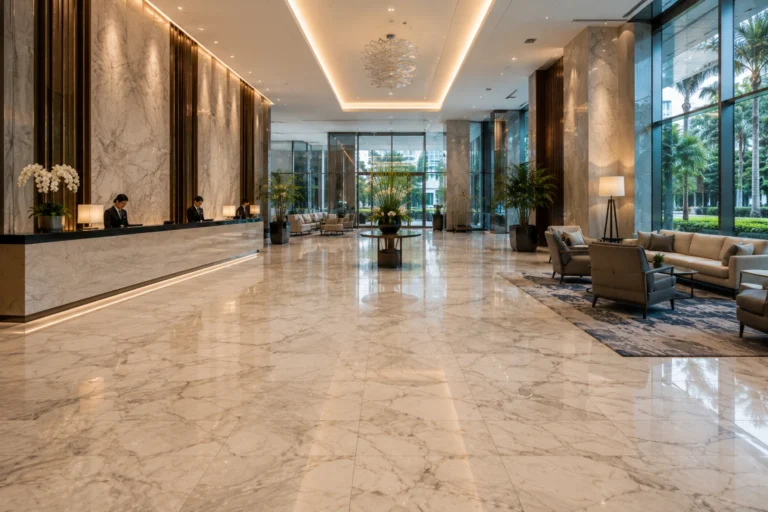
Because the design sits in a printed glaze, glazed porcelain can convincingly reproduce Calacatta marble, weathered oak, raw concrete or virtually any surface a designer can imagine. For a hotel lobby, a flagship retail store on Orchard Road or a restaurant where the floor is part of the brand experience, that design range is the deciding factor. Glazed porcelain is, in effect, the designer’s tool.
The Homogeneous Aesthetic: Limitation or Feature?
Homogeneous tiles are constrained by their through-body construction. Reproducing intricate veining or photorealistic wood grain consistently through the full thickness is technically difficult, so the palette skews toward solid colours, salt-and-pepper speckles and clean, simple patterns.
But that “limitation” is often exactly the look that corporate, institutional and transit spaces want: calm, uniform, architectural and timeless. So reframe the question. If your brief is “must look like statement marble,” glazed wins. If it is “must look immaculate after a decade of abuse and clean up under a scrubber every night,” homogeneous wins. A narrower palette can be the right palette.
What It Really Costs in Singapore (Total Cost of Ownership)
Sticker price is the least useful number in a commercial flooring budget. Singapore tiling costs have several moving parts, and 2025 to 2026 quotes now factor in the 9 percent GST and a tightening labour market.
Material Costs Compared
On material alone, the two options are broadly comparable:
- Homogeneous (full-body) porcelain: roughly S$3 to S$10 psf
- Glazed porcelain: roughly S$3 to S$10 psf
Basic ceramic sits lower, but it is not suitable for heavy commercial floors and should not be on your shortlist for high-traffic zones. Because the two are so close on material price, cost rarely decides the homogeneous versus glazed question on its own.
Installation and the Hidden Costs
Installation is where budgets actually move. Here is a realistic breakdown of what a complete commercial tiling job involves in Singapore:
Cost component | Indicative range (psf unless stated) |
Material (homogeneous or glazed) | S$3 to S$10 |
Installation labour (standard 600 x 600 mm) | S$6.50 to S$8 |
Installation labour (large format, e.g. 1200 x 600 mm) | S$10 and up |
Hacking and disposal of existing floor | S$3 to S$6 |
Wastage allowance | 10 to 15 percent of material |
Waterproofing (wet zones) | Project-dependent |
Large-format tiles cost more to lay because they need a two-person lift, suction tools and a substrate flat enough to meet BCA’s lippage tolerance of 0.5 mm. Do not forget skirting (charged per foot run), and always build in a contingency for uneven substrates discovered after hacking.
Pro tip: Always obtain two to three itemised quotes and confirm exactly what is included: material, installation, hacking, levelling, waterproofing and disposal. Opaque, lump-sum quotes are where nasty surprises hide. An experienced floor tiling contractor in Singapore should be able to set this out line by line.
Lifecycle Cost: The Number That Actually Matters
Where total cost of ownership truly diverges is over the building’s life. In the most abrasive environments, a full-body floor that hides wear can defer the replacement cycle, while a glazed floor that loses its surface in a grit-heavy walkway may need attention sooner. Match the tile to the traffic, and you protect the investment either way. The cheapest floor on day one is rarely the cheapest floor over fifteen years.
A Practical Decision Framework: Which to Use Where
Rather than crowning a single winner, specify by zone. This is the framework most competing guides leave out:
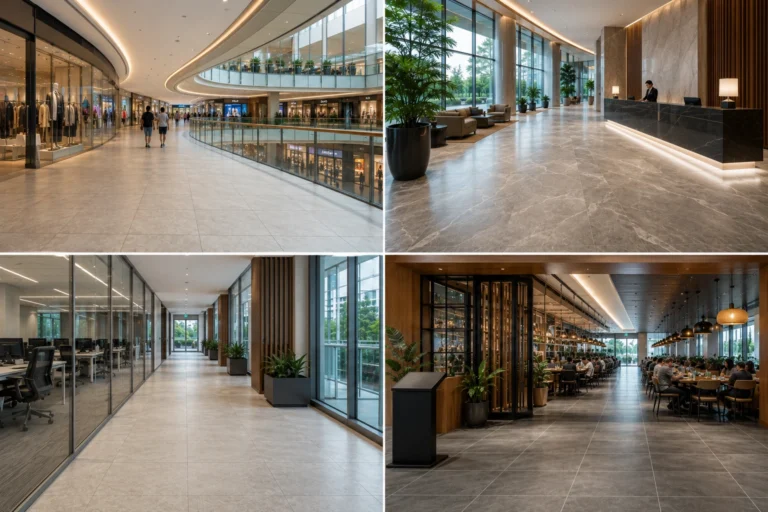
- Airports, transit, public walkways, industrial and back-of-house floors. Choose homogeneous (full-body) porcelain. Maximum abrasion resistance, wear and chips stay invisible, and it thrives under heavy machine cleaning.
- Hotel lobbies, flagship retail, restaurants, premium F&B front-of-house. Choose high-quality glazed porcelain (PEI 5) in the required slip finish. Design realism plus commercial-grade durability.
- Mixed-use developments and malls. Often a blend: homogeneous in service corridors and high-grit thoroughfares, glazed (or double-charged, see below) in feature and tenant areas.
- Wet zones (kitchens, pool decks, exposed entries). Either body, but finish first. Specify R11 to R13 and a high P-value to SS 485, and verify it.
Key takeaways: the three numbers to confirm before you sign off
- Water absorption of 0.5 percent or less (confirms true porcelain).
- The correct wear rating: PEI 4 to 5 for glazed, or deep-abrasion compliance for full-body.
- The SS 485 slip classification for that specific location.
The Overlooked Third Option: Double-Charged Porcelain
There is a middle path many Singapore specifiers do not consider. Double-charged (double-loaded) porcelain fuses a thick layer of design pigment, around 3 to 4 mm, onto a porcelain base under intense pressure. That thick surface layer delivers much of full-body’s wear-hiding benefit, but at a lower cost than fully homogeneous tile, while allowing richer surface designs than solid-colour homogeneous.
It is a strong fit for malls, lobbies and transit waiting areas, that is, moderate-to-heavy traffic that also has to look good. Knowing where double-charged sits in the porcelain family (alongside homogeneous and glazed) gives you a more precise toolkit than a simple either/or.
Before You Specify: A Commercial Buyer's Checklist
Use this as a final pre-purchase checklist for any high-traffic Singapore project:
- Confirm water absorption of 0.5 percent or less on the datasheet (true porcelain).
- Confirm the correct wear rating for the tile type (PEI 4 to 5 for glazed; deep-abrasion compliance for full-body).
- Confirm the SS 485 slip class for the specific zone, and have it verified by an accredited lab.
- Match the finish to wet or dry conditions (texture for wet and entrance areas).
- Get two to three itemised quotes covering material, installation, hacking, levelling, waterproofing and disposal.
- Plan 10 to 15 percent wastage and a contingency for substrate surprises.
- Check the 0.5 mm lippage tolerance for large-format tiles.
- Verify contractor credentials (HDB-approved, BCA-registered) and ask to see a relevant project portfolio.
The Verdict on Homogeneous vs. Porcelain Floor Tiles
For Singapore’s high-traffic commercial properties, “homogeneous vs. porcelain floor tiles” is really full-body versus glazed porcelain, and there is no single winner, only a right fit for each space. Homogeneous (full-body) porcelain is the gold standard where mechanical endurance is everything: airports, stations, walkways and industrial floors. High-grade glazed porcelain is the smarter pick where design and brand image matter and the traffic is heavy but civilised: lobbies, retail and hospitality. Double-charged porcelain bridges the two.
Whichever you choose, the same three checks protect your investment: water absorption at or below 0.5 percent, the correct wear rating for the tile type, and a verified SS 485 slip classification for the actual use of each area. Get those right, and the floor will outlast the trends above it.
If you are planning a commercial fit-out or refurbishment, the most reliable next step is a site assessment with an experienced, BCA-registered specialist who can match the tile, finish and installation method to your traffic and compliance needs. Leong Yik Engineering and Contractor, an HDB-approved and BCA-registered tiling contractor based at 18 Mandai Estate, #03-08, Multi-Wide Industrial Building, Singapore 729910, handles both residential and commercial flooring across the island. You can reach the team on +65 6693 2359 to discuss specification and installation for your project.
This article is for general guidance. For project-specific specification and compliance, consult a qualified flooring specialist and verify current SS 485 and BCA requirements, as well as prevailing Singapore prices, for your particular project.
FAQ Section
Is a homogeneous tile better than a porcelain tile?
The question is slightly misleading, because a homogeneous tile is a type of porcelain, specifically full-body porcelain. The meaningful comparison is full-body (homogeneous) porcelain versus glazed porcelain. Full-body wins on pure abrasion endurance; glazed wins on design flexibility.
Is homogeneous tile the same as full-body porcelain?
Yes. “Homogeneous,” “full-body” and “through-body” all describe the same thing: a porcelain tile whose colour and material run uniformly from surface to base, with no separate decorative glaze on top.
What is the difference between glazed and full-body porcelain?
Both share an impervious porcelain body. Glazed porcelain has a printed, fired-on surface coating that carries the design; full-body has its colour throughout and no glaze. The glaze gives design freedom; the full-body construction hides wear and chips.
Which lasts longer in a high-traffic commercial space?
In the most abrasive environments (airports, walkways, industrial floors), full-body homogeneous porcelain typically lasts longest, because wear and chips reveal the same colour beneath. For most commercial floors, a quality PEI 5 glazed porcelain also performs excellently.
Are homogeneous and glazed porcelain both waterproof?
Both are classified as impervious, with a water absorption rate of 0.5 percent or less under ISO 10545-3. That makes both highly suitable for Singapore’s humid, rain-prone conditions.
What PEI rating do I need for a commercial floor?
For heavy commercial traffic, specify PEI 4 or, ideally, PEI 5 for glazed tiles. Note that PEI grades glazed surfaces; full-body unglazed tiles are assessed by deep abrasion (ISO 10545-6) instead.
What slip rating do I need for a commercial floor in Singapore?
Specify to SS 485:2022 based on the location: roughly R9 to R10 for dry interiors, R10 minimum for entrances and dining areas, R12 or higher for commercial kitchens, and R11 and above for wet or outdoor areas. Have the rating verified by an accredited lab.
Is homogeneous tile more slip-resistant than glazed?
Not inherently. Slip resistance depends on the finish, not the body. Both types come in grippy textured finishes and in slippery polished finishes. Choose the finish for safety and the body for durability and looks.
Can glazed porcelain handle heavy commercial traffic?
Yes, provided it is PEI 4 or 5 and finished to the correct slip rating. The main caveat is that a breached or worn glaze exposes the body colour, which is more visible than wear on a full-body tile.
How much do these tiles cost in Singapore?
As a 2025 to 2026 guide, expect roughly S$3 to S$10 psf for material (homogeneous or glazed) plus S$4 to S$12 psf for installation, before 9 percent GST, hacking, waterproofing and wastage. Large-format tiles raise labour costs to S$10 and up per square foot.
What is double-charged porcelain, and when should I use it?
Double-charged (double-loaded) porcelain has a thick (around 3 to 4 mm) design layer fused onto a porcelain base. It offers much of full-body’s wear-hiding benefit with richer designs and a lower price, making it a good fit for malls, lobbies and transit waiting areas.
Do I need a BCA-registered or HDB-approved contractor for commercial tiling?
Engaging a properly registered contractor (such as an HDB-approved, BCA-registered firm) is strongly advisable. It signals competence with local standards, including SS 485 slip compliance and BCA lippage tolerances, and gives you accountability if issues arise.