

Introduction: Why "Just Renovate" Isn't an Option in an HDB Flat
For many new resale flat owners, renovation planning starts with mood boards, contractor quotes and a rough sense of the layout changes they want. What often comes as a surprise is that some of those changes cannot legally begin until HDB has issued written approval. This isn’t a formality tucked away in the fine print: HDB flats share structural walls, floor slabs, beams and building services with every other unit in the block, so a change that seems purely cosmetic to one owner can affect the safety and integrity of the whole structure. Renovation in an HDB flat is therefore not only a design decision. It is also a regulatory one, and understanding which works fall under HDB’s permit system before signing a contractor’s quotation can save homeowners high costs, delays, and stress.
Understanding the HDB Renovation Permit System

Before listing specific works, it helps to understand the logic behind HDB’s approach. Not every renovation carries the same level of risk to the building or to neighbouring units. Some works could compromise structural integrity, waterproofing or fire safety if done incorrectly, so they require formal approval before work starts. Others carry lower risk but still need to follow set technical guidelines. A third group has no meaningful impact on the shared building and can proceed without HDB’s involvement at all. The level of risk a piece of work poses determines which group it falls into, not a fixed or arbitrary list.
The Three Categories of Renovation Works
HDB’s renovation control framework distinguishes between works that require a formal permit, works that must comply with published technical guidelines without a separate permit application, and works that require neither. According to HDB’s own guidance, renovations outlined under its building and sanitary work guidelines require a permit and must not begin until that permit is granted. Renovations outside this list are not exempt from oversight altogether: they still have to comply with HDB’s published technical conditions, and work that ignores those conditions is treated as unauthorised regardless of whether a permit was needed in the first place.
The table below summarises how this works in practice.
Category | What it means for the homeowner | Typical examples |
Permit required | Work cannot start until HDB grants written approval, submitted via a DRC-listed contractor | Hacking structural or partition walls, floor finish replacement, bathroom works, window replacement |
Guidelines apply, no separate permit | No formal application, but the work must follow HDB’s technical conditions and be carried out by an appropriately licensed tradesperson | Certain electrical works, air-conditioner installation, minor sanitary fitting changes |
Neither required | Homeowner can proceed without HDB involvement | Painting, wallpapering, loose furniture, most built-in fittings with no hacking |
Why the Distinction Matters to Homeowners
Getting this classification wrong has real consequences. Starting permit-required work without approval, even unintentionally, exposes the homeowner to enforcement action and delays that can push back a move-in date. Assuming that everything needs a permit, on the other hand, leads to unnecessary contractor fees and wasted time on applications that were never required. Knowing which category a specific piece of work falls into, rather than guessing based on what a previous flat owner did, is what keeps a renovation on schedule.
Works That Require an HDB Permit
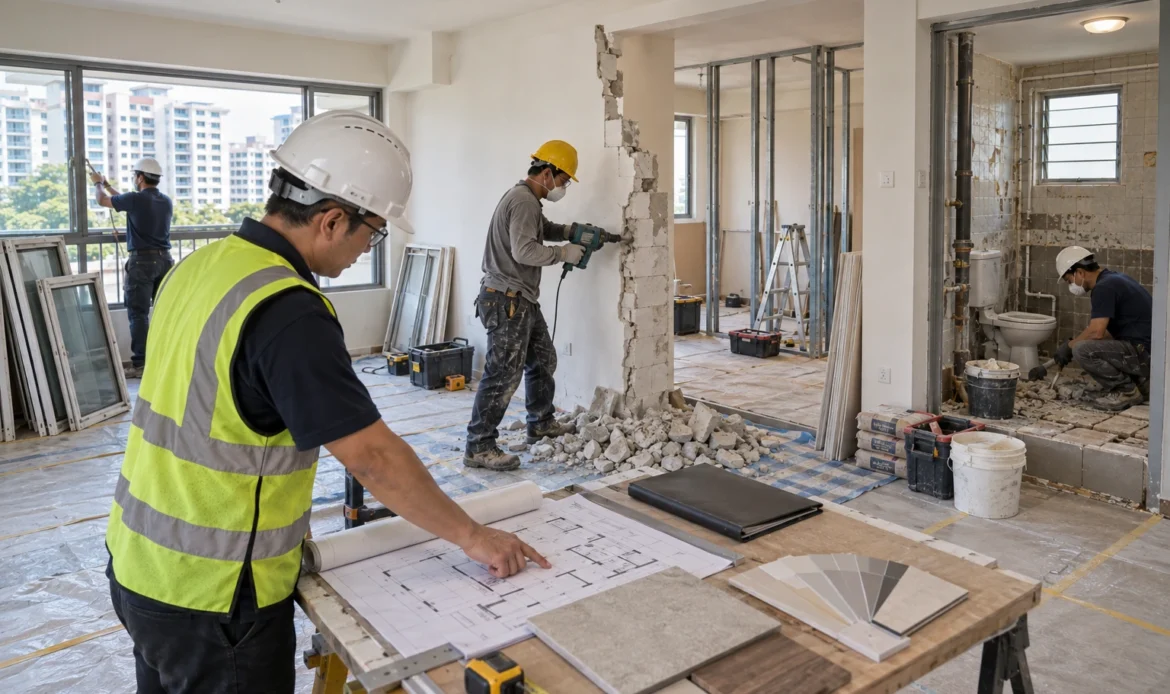
The works below consistently require approval before any physical work begins, each regulated for a reason connected to structural safety, waterproofing or fire protection.
Hacking of Structural and Partition Walls
Structural walls, together with reinforced concrete columns, beams and floor slabs, carry the load of the flats above and cannot be hacked under any circumstances, regardless of permit status. Partition walls, which divide internal spaces without bearing structural load, may be permitted for demolition, but only after HDB or an engaged professional confirms the wall is genuinely non-structural. This distinction matters because a wall that looks like a simple partition can still play a structural role depending on the flat’s design.
For demolition works, HDB requires the renovation contractor to submit the flat’s floor plan alongside the application so the classification can be properly evaluated. In some cases, a Qualified Person is required to inspect and supervise the demolition to ensure no load-bearing element is damaged in the process.
Changes to Floor Finishes
Removing existing floor tiles, screed or other finishes and replacing them with new materials generally falls under permit-required works, particularly in wet areas where waterproofing membranes sit beneath the surface. Thickness limits for new floor finishes are periodically reviewed, so these should be confirmed directly with HDB or a DRC-listed contractor at the time of application rather than assumed from an older source. Homeowners planning tiling work in detail can refer to our dedicated guide on HDB floor tiling rules for a fuller breakdown of finish types and wet-area considerations.
Toilet and Bathroom Works
Bathroom and toilet renovations are treated with particular care because the waterproofing membrane beneath the tiles prevents water from seeping into the unit below. Any work that disturbs this membrane, including hacking existing tiles or altering sanitary pipe routes, requires prior approval. Many BTO flats are also subject to a restriction period after key collection during which wall and floor finishes in wet areas cannot be removed, to protect the original waterproofing while it remains under warranty. Resale flat owners should not assume this restriction has lapsed simply because the flat has changed hands; the condition is tied to the flat’s age from key collection, not its ownership history.
Adding or Removing Internal Walls
Beyond full hacking works, installing a new partition wall or reconfiguring room layouts also falls under permit control, since new walls add load to the floor slab and must be assessed for weight and placement. Where a proposed wall change is more complex, such as spanning a larger area or interacting with existing structural elements, HDB may require input from a Professional Engineer to confirm the design is safe before approval is granted.
Window Replacement
Window works sit under a different set of controls, because they affect both the building’s external facade and its fire safety systems. Only a BCA-approved window contractor listed with HDB is permitted to carry out window installation or replacement, and the permit process exists to ensure replacement units meet the structural and fire safety standards expected of a shared facade. This applies whether the change is a full window replacement or a modification to an existing frame.
Works That Require Notification Only
A smaller group of works sits between full permit applications and no requirement at all. These are works where HDB expects the homeowner to engage an appropriately licensed tradesperson and follow published technical conditions, but where a full permit application through a renovation contractor is not the standard route. Certain electrical works fall here: some require a permit handled through a Licensed Electrical Worker’s application, while others simply need to comply with HDB’s stipulated guidelines once carried out by a properly licensed worker. Air-conditioner installation follows a similar pattern, requiring a BCA-trained installer and compliance with published conditions. The practical difference is procedural: these works skip the evaluation and floor-plan submission process, but ignoring the licensed-worker requirement still risks the work being treated as unauthorised.
Works Homeowners Commonly Assume Need a Permit, But Don't
A significant amount of unnecessary anxiety, and unnecessary contractor fees, comes from homeowners assuming every visible change to their flat needs sign-off. The following works generally fall outside permit requirements, though they still need to be carried out sensibly.
Painting, Wallpaper, and Cosmetic Finishes
Painting walls and ceilings, applying wallpaper, or refreshing existing surface finishes has no structural or shared-building impact and does not require a permit. This remains one of the few genuinely unrestricted categories of HDB renovation.
Furniture and Fixture Installation
Built-in wardrobes, cabinetry, loose furniture and similar fittings generally sit outside permit requirements, provided they don’t involve hacking into walls or floors. Where this changes is when the installation brings in electrical work, such as new power points built into a wardrobe, or plumbing connections for a fitted feature. At that point, it is the electrical or plumbing element that triggers the relevant licensing requirement, not the furniture itself.
Vinyl Flooring Overlay Under the Threshold
There is a meaningful difference between overlaying vinyl flooring directly on top of existing tiles and removing the existing tiles before laying new flooring. Overlay work, applied over the existing surface without disturbing it, typically does not trigger a permit in the way that full floor finish replacement does, provided the combined thickness stays within HDB’s current limits. Because this threshold has been revised over time, homeowners should confirm the exact allowable thickness with their DRC-listed contractor or directly with HDB before committing to an overlay approach.
How the HDB Permit Application Process Works

Who Can Submit the Application
Permit applications cannot be submitted by the homeowner directly. They must be made electronically by a contractor listed in HDB’s Directory of Renovation Contractors (DRC), with the homeowner’s signed acknowledgement form attached. This exists as a safeguard: DRC-listed contractors have been through HDB’s registration process and are expected to understand the guidelines that protect the block’s structural integrity, which a homeowner submitting independently would not be positioned to verify.
Typical Application Timeline
Processing time varies with the complexity of the works involved. Straightforward applications with no structural evaluation generally move faster than those requiring wall demolition assessment or sign-off from a Qualified Person. Because processing times shift, homeowners planning a move-in date should build in a buffer, check the current expected timeline with their contractor, and avoid committing to a fixed start date before the permit is actually granted. Approval status can be tracked through My HDBPage once the application has been submitted.
What Happens If Work Starts Without Approval
Starting permit-required work before approval is granted is treated as unauthorised work, and the consequences fall on the homeowner rather than only the contractor. HDB can require the work to be discontinued, corrected, or removed entirely, with the flat reinstated to its original condition at the homeowner’s expense. Where the work is allowed to remain, an administrative fee still applies. This is a genuine risk for homeowners compressing their timeline to meet a move-in deadline, and rushing past the approval stage rarely saves the time it appears to, since reinstatement and reapplication can add far more delay than waiting for the original permit would have.
Why the Renovation Contractor You Choose Matters
HDB-Registered Contractors and the Renovation Contractors Register
Only contractors listed in the DRC are permitted to carry out renovation works in HDB flats, and only these contractors can submit permit applications on a homeowner’s behalf. Listing in the DRC means a contractor has met HDB’s registration criteria and completed the required training, though HDB is clear that this listing is a registration status rather than an endorsement of workmanship quality. Contractors are also subject to a demerit point system: accumulating a set number of points within a defined period can result in suspension or delisting.
Leong Yik Engineering & Contractor is a firm listed in HDB’s Directory of Renovation Contractors that carries out this category of work, illustrating the registration status homeowners should look for when comparing quotations. Checking a contractor’s current DRC listing directly through HDB’s directory takes only a few minutes and is worth doing, regardless of how you found the contractor.
Risks of Using an Unlicensed or Unregistered Contractor
Engaging a contractor who is not listed in the DRC for permit-requiring work creates real exposure for the homeowner. Because only DRC-listed contractors can submit renovation applications, work carried out by an unregistered party for permit-required categories cannot be properly authorised, placing it squarely in unauthorised territory regardless of the quality of the finished work.
This can mean reinstatement at the homeowner’s cost, difficulty resolving disputes since HDB is not a party to a private engagement, and complications if the unauthorised work later surfaces during a resale check. Verifying DRC status before signing anything remains the simplest way to avoid this outcome.
Conclusion
Singapore’s HDB renovation permit system is built around risk, not red tape. Works that could affect structural safety, shared waterproofing, or fire protection require a permit and cannot begin until it is granted. A smaller set of works needs a licensed tradesperson and compliance with published guidelines. Everything else, from painting to loose furniture, can generally proceed without HDB’s involvement.
Understanding which category a planned renovation falls into, checking figures like thickness limits and processing times against current sources, and confirming a contractor’s DRC status before signing anything are the practical steps that keep a renovation on schedule. With that framework in mind, most homeowners can review their plans and quickly see what needs checking before the first hammer comes out.