The Ceiling Stain That Kept Growing
Why the Water You See on Your Ceiling Rarely Comes from Directly Above
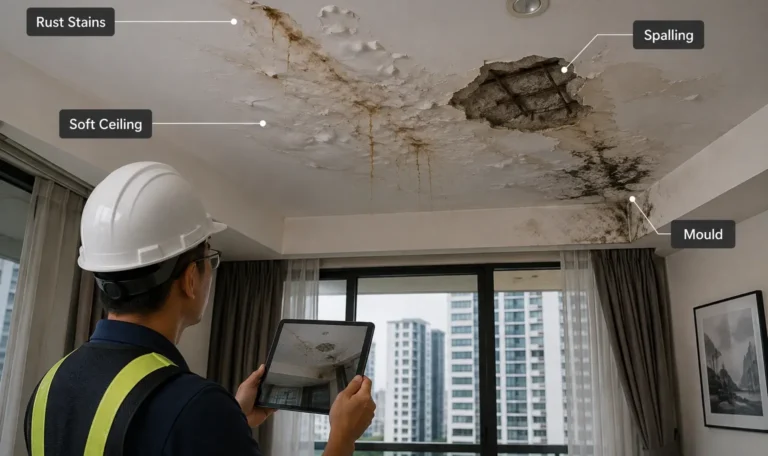
Most Singapore property owners discover a roof leak the same way: a water stain appears on the ceiling, they look directly above it, patch that area, and consider it done. The stain returns within weeks. What actually happened is that water entered the building several metres away and travelled horizontally along the rebar or beam soffit inside the concrete slab before finding a low point directly above the stain. This is how reinforced concrete construction works. Water follows the path of least resistance through internal voids and along steel reinforcement before it drips through. The visible stain shows you where the water eventually escaped. It tells you almost nothing about where it entered.The DIY Sealant Trap and Why It Fails Within One Monsoon Season
Silicone sealant and bituminous brush-on products fail in Singapore’s climate for two compounding reasons. First, near-equatorial UV intensity degrades surface-applied sealants at a rate that temperate-climate product specifications do not account for. Second, Singapore’s day-night temperature differential causes concrete to expand and contract continuously, reopening any crack that has been sealed without addressing the underlying movement. Surface sealants also do not penetrate the screed or membrane layer beneath. They address surface appearance, not the system itself.Why Singapore Properties Are Particularly Vulnerable to Roof Leakage
What Flat Roofs Do Well and What They Cannot Handle in Singapore’s Climate
The majority of Singapore’s HDB blocks, condominiums, and commercial buildings use flat or near-flat roof systems. They are efficient to build and create usable rooftop space. Their fundamental limitation in a high-rainfall climate is that water must be actively drained rather than running off by gravity. Any blockage or inadequate drainage creates ponding, which exerts sustained hydrostatic pressure directly on the membrane.The Role of Monsoon Rainfall, Ponding, and UV Degradation in Singapore’s Roof Leakage Pattern
Singapore receives over 2,300mm of rainfall annually, with peak intensity during the second inter-monsoon period in October and November, and the Northeast Monsoon from December to early March. Every centimetre of ponded water adds pressure that a degraded membrane can increasingly resist. Singapore’s UV index also regularly reaches 12 to 14, among the highest globally, accelerating the degradation of most membrane materials well beyond the rates described in product datasheets for cooler markets.The Lifespan Problem: When Standard Waterproofing Membranes Reach the End of Their Service Life
Most polyurethane and modified bitumen membranes applied in Singapore have a functional service life of 10 to 15 years under local conditions. Most property owners do not track the installation date and are unaware when the membrane approaches the end of service. End-of-life failure is not a sudden event. It presents as multiple small failures occurring increasingly close together: first one stain, then another nearby, then a third. This is the membrane communicating that spot repairs are no longer adequate.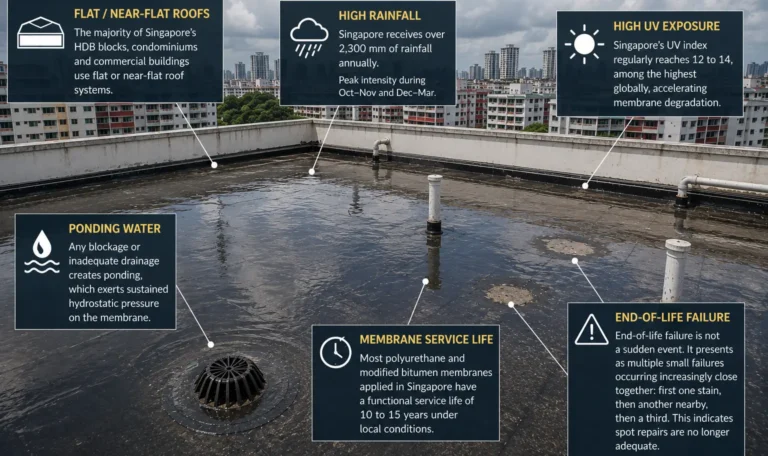 The Five Most Common Causes of Roof Leakage in Singapore Properties
Cause 1: Degraded or Failed Waterproofing Membrane
The membrane is the primary barrier between the concrete slab and rainwater. When it degrades, cracks, or delaminates from the substrate, it loses the ability to resist water pressure. This is the most common cause in Singapore buildings older than ten to fifteen years, and it typically requires full membrane replacement over the affected area rather than spot patching.Cause 2: Failed Expansion Joints
Singapore’s thermal cycling is the primary enemy of expansion joint seals. These designed breaks in concrete structures allow movement without cracking, but the flexible sealant filling them eventually hardens, loses elasticity, and cracks under continuous cycling. Failed expansion joints are especially common in commercial buildings, warehouses, and large flat roofs where joint spans are longer and movement forces are greater.Cause 3: Blocked or Inadequate Roof Drainage and Ponding Water
A blocked roof drain converts a flat roof into a temporary pond. Common sources of blockage in Singapore include leaf debris, wind-blown rubbish, bird nesting material, and root intrusion from rooftop plants. Adequate drainage is a design requirement, not a maintenance option: a poorly drained roof in Singapore cannot be reliably waterproofed without simultaneously addressing the drainage design.Cause 4: Cracked or Deteriorated Screed Layer
Not every roof leak originates at the membrane. The screed layer beneath it, which provides slope for drainage and serves as the base for the membrane, can crack from thermal movement, loading, or age, creating water pathways even when the membrane above is technically intact. Screed failure is a more complex repair because it requires removal of the membrane above before the screed can be addressed.Cause 5: Failed Sealant at Pipe Penetrations and Parapet Walls
Every pipe, cable conduit, or drainage outlet that passes through a roof creates a break in the membrane requiring a specialist seal. These seals fail because the penetration moves differently from the concrete slab under thermal and vibration loads, breaking the bond at the edge. The base of a parapet wall where it meets the horizontal roof surface is consistently the most common failure point in Singapore flat roofs.Before Calling Anyone: Is This Your Responsibility or Someone Else’s?
HDB Flats: Who Is Responsible for Roof Leakage Repair?
HDB maintains common property, which includes the external roof structure of HDB blocks. If the leak originates from the external roof, the flat owner should report to HDB first before engaging a private contractor. A leak originating from the wet area floor of the unit above is handled differently: the owner of the unit above is typically responsible for their own wet area waterproofing. Document the leak with photographs and submit through HDB’s MyRequest portal before any repair is authorised.Condominiums: What MCST Covers and What the Unit Owner Must Handle
For condominium owners, responsibility is governed by the Building Maintenance and Strata Management Act (BMSMA). The MCST covers common property, typically including the exterior roof, exterior walls, and shared drainage. The unit owner is responsible for waterproofing within their own wet areas and internal ceiling. For a leak passing through one unit’s floor into the ceiling of the unit below, the MCST should be involved before either unit owner engages a private contractor unilaterally.Commercial and Industrial Properties: Owner and Tenant Responsibilities Under the Lease
Commercial tenants face a different risk from the same ceiling stain. Standard Singapore commercial leases make the landlord responsible for the building’s structure and external skin, including the roof, but many tenants end up paying for repairs they are not obligated to fund. Document the leak with timestamped photographs, provide written notice to the landlord or building manager, and allow a reasonable response window before engaging a private contractor.What a Professional Roof Leakage Repair Actually Involves
Step 1: Leak Tracing – Why Finding the Real Source Takes More Time Than the Repair
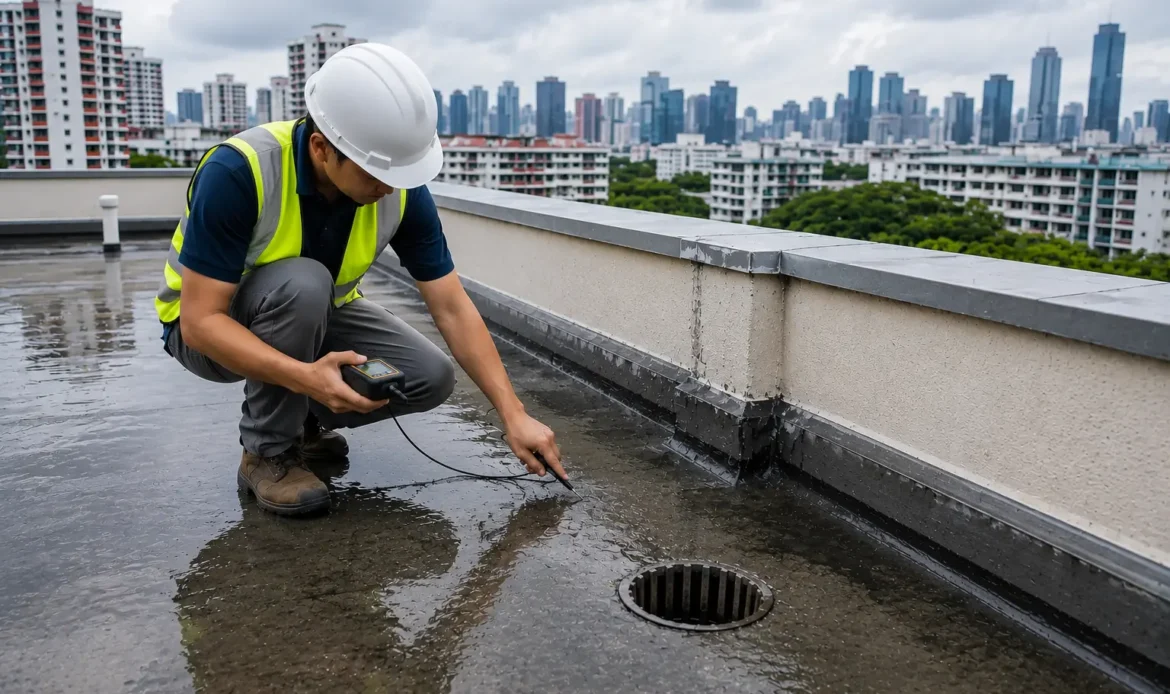
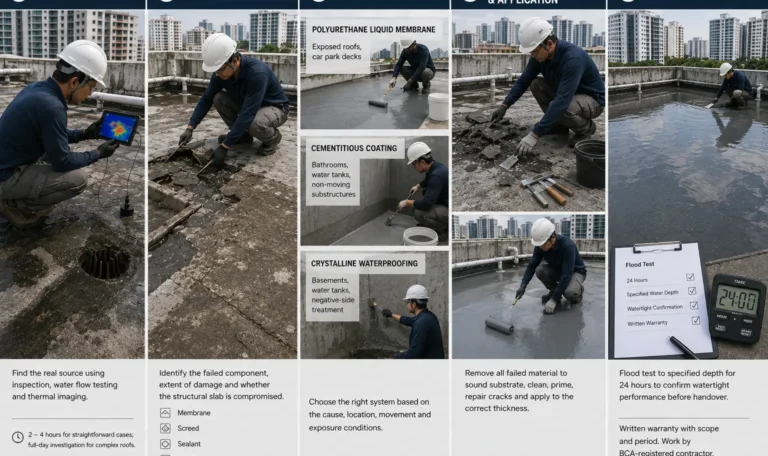
Leak tracing begins at the visible damage point and works backwards to locate the actual entry point using inspection, water flow testing, and, in complex cases, thermal imaging. This step cannot be skipped. Applying any system without confirming the source results in the new membrane covering the wrong area and failing during the first rainstorm. For a straightforward case, tracing takes two to four hours; for a large or complex roof with multiple potential sources, a full-day investigation is not unusual.Step 2: Assessment of the Affected System
The assessment determines which component has failed (membrane, screed, sealant, drainage, or a combination), the extent of the affected area, and whether the structural slab has been compromised. This step directly determines the repair method and cost. The same visible symptom may require a spot repair, a full membrane replacement, a screed reinstatement, or a drainage upgrade, depending on the assessment.Step 3: Selection of the Correct Waterproofing System for the Cause
| System | Best Application | Flexibility Under Movement | Singapore Climate Suitability |
| Polyurethane liquid membrane | Exposed flat roofs, car park decks | High (elastic, accommodates thermal cycling) | Excellent for exposed rooftop surfaces |
| Cementitious coating | Bathrooms, water tanks, non-moving substructures | Low (rigid, cracks under movement) | Suitable for interior wet areas only |
| Crystalline waterproofing | Concrete basements, water tanks, negative-side treatment | Not applicable (penetrates concrete matrix) | Suitable where interior-side treatment is required |
When Polyurethane Membrane Is the Right System
Polyurethane liquid membrane is applied as a liquid that cures to a seamless, flexible coating. Its elasticity accommodates Singapore’s continuous thermal movement in concrete without cracking. It is the appropriate primary system for exposed flat rooftop and car park deck work in Singapore.When Cementitious Waterproofing Is Used
Cementitious coating is a rigid cement-based system for wet areas not subject to movement: bathrooms, water tanks, and substructures. It should not replace polyurethane on exposed rooftops because it will crack under Singapore’s thermal cycling.When Crystalline Waterproofing Is Appropriate
Crystalline waterproofing penetrates concrete and generates insoluble crystals within the matrix to block water pathways. It is appropriate for concrete water tanks, basement walls under hydrostatic pressure, and where the treatment must be applied from the interior surface when access from above is not possible.Step 4: Surface Preparation and Application
Most repairs that recur within months trace back to one cause: inadequate surface preparation. Removing all failed material to sound substrate, cleaning, priming, and treating cracks with repair mortar is not optional preparation; it is the work on which the membrane’s entire service life depends. Application thickness must also meet the system’s minimum dry film thickness specification; thin application is the most common shortcut that causes premature failure in Singapore.Step 5: Testing and Flood Test Before Handing Over
Before any job is handed over, one objective confirmation is available: the flood test. Water is pooled on the repaired surface to a specified depth for 24 hours to confirm the membrane is watertight under sustained pressure. Accepting a repair without a flood test removes the only quality confirmation available. The work should also carry a written warranty specifying the system applied, the warranty period, and who is liable for failure. BCA-registered contractors in Singapore are held to defined standards for structural and waterproofing works.Warning Signs That Mean You Should Not Wait