
Introduction: The Flooring Decision That Shapes the Rest of the Renovation
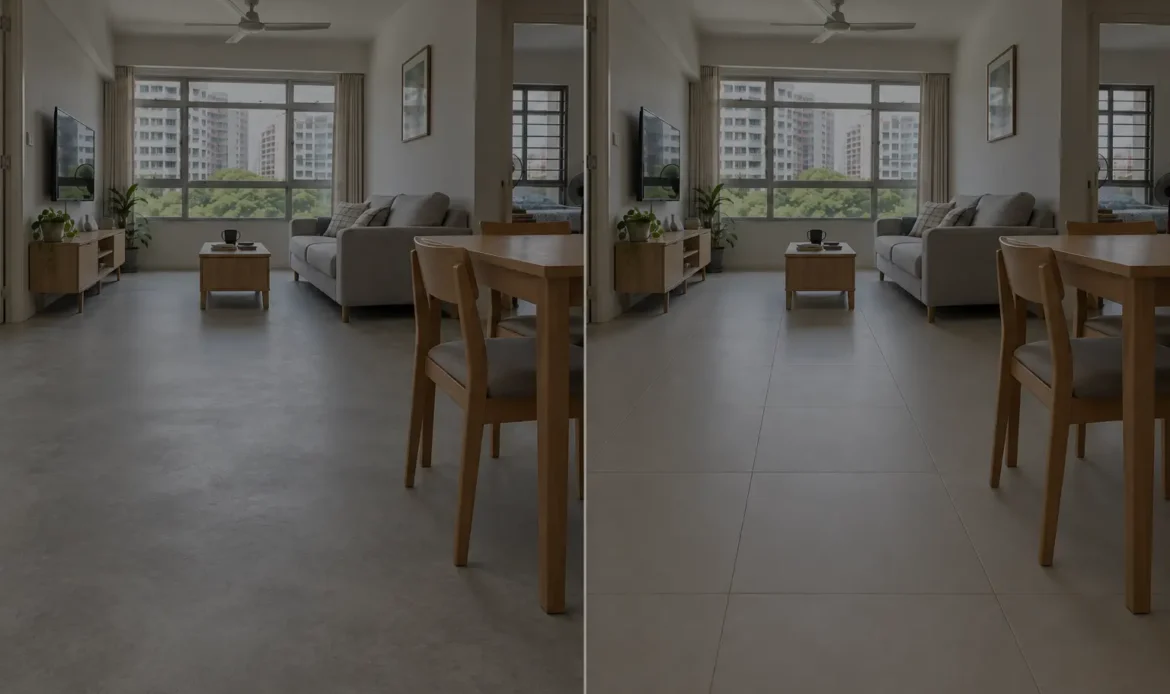
Somewhere in the middle of most HDB renovation planning, the flooring question arrives and refuses to be a quick decision. Cement screed has grown from a niche industrial look into one of the most requested finishes in Singapore homes, often pitched as a seamless alternative to the tried-and-tested floor tile. But this isn’t purely an aesthetic choice. The finish a homeowner picks affects renovation cost, whether HDB permit requirements come into play, how the floor performs over the years ahead, and how much maintenance the household is signing up for. Getting a clear picture of both options before committing avoids the more common mistake: choosing a finish for how it looks in a photo, then living with trade-offs that were never explained upfront.
What Is Cement Screed and Why Has It Become Popular in Singapore Homes
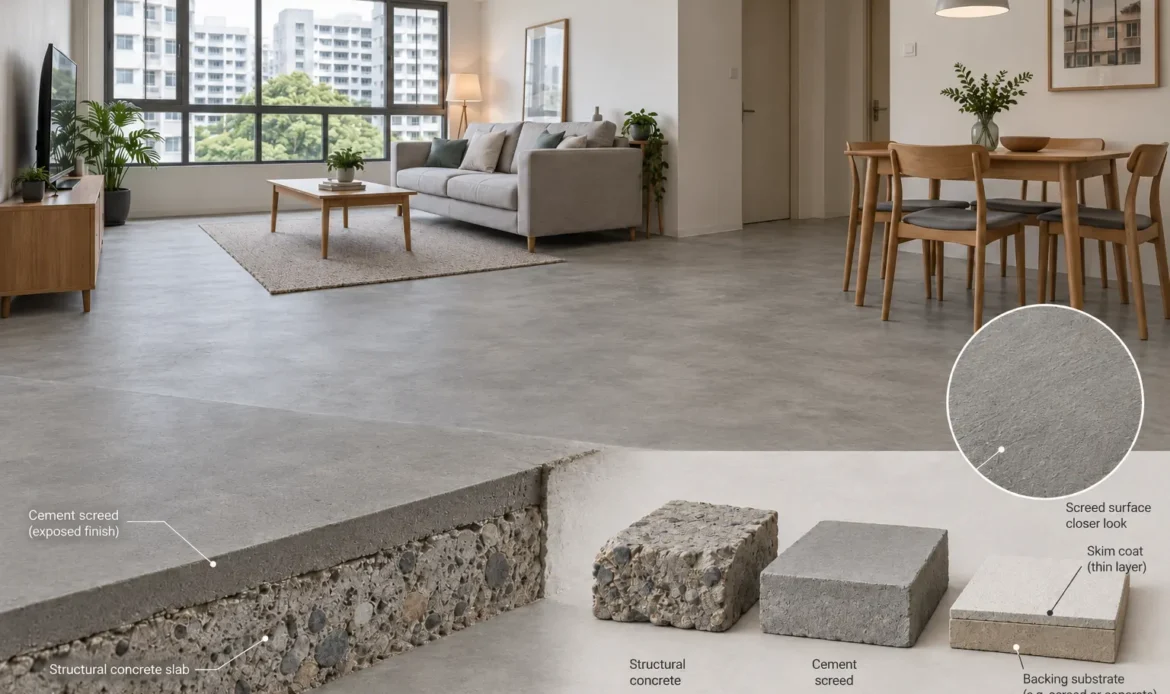
Cement screed, in its exposed form, is a levelled cementitious layer applied over the structural floor slab and left as the visible finish rather than covered with tiles, vinyl or other materials. Instead of a decorative surface sitting on top of the floor, the floor itself becomes the finish, typically sealed to reduce porosity and improve durability. Its rise in HDB flats has tracked closely with the popularity of industrial-style and minimalist interiors, where the muted, slightly imperfect grey surface reads as understated rather than unfinished. It suits a particular design direction well, but it is not a universally superior choice, and homeowners drawn purely by the look should weigh it against the practical factors below.
How Cement Screed Differs From Standard Concrete or Skim Coat
A common point of confusion is treating screed, raw concrete and skim coat as interchangeable terms. Raw concrete is the structural slab itself, not intended as a finished surface and generally too uneven and porous to leave exposed. Skim coat is a thin cosmetic layer, usually just a few millimetres, applied mainly to smooth out minor imperfections rather than to bear foot traffic as a standalone finish. Cement screed sits between the two: a purpose-mixed cementitious layer, applied at a meaningful thickness and designed to be levelled, cured properly and used as either a base for tiling or a finished surface in its own right. A screed cured to the standard needed for a durable exposed finish behaves very differently from a thin skim coat mistaken for the same thing, and expecting skim-coat results from proper screed installation, or vice versa, is where durability expectations often go wrong.
Cement Screed vs Floor Tiles: The Practical Differences
Cost Per Square Metre
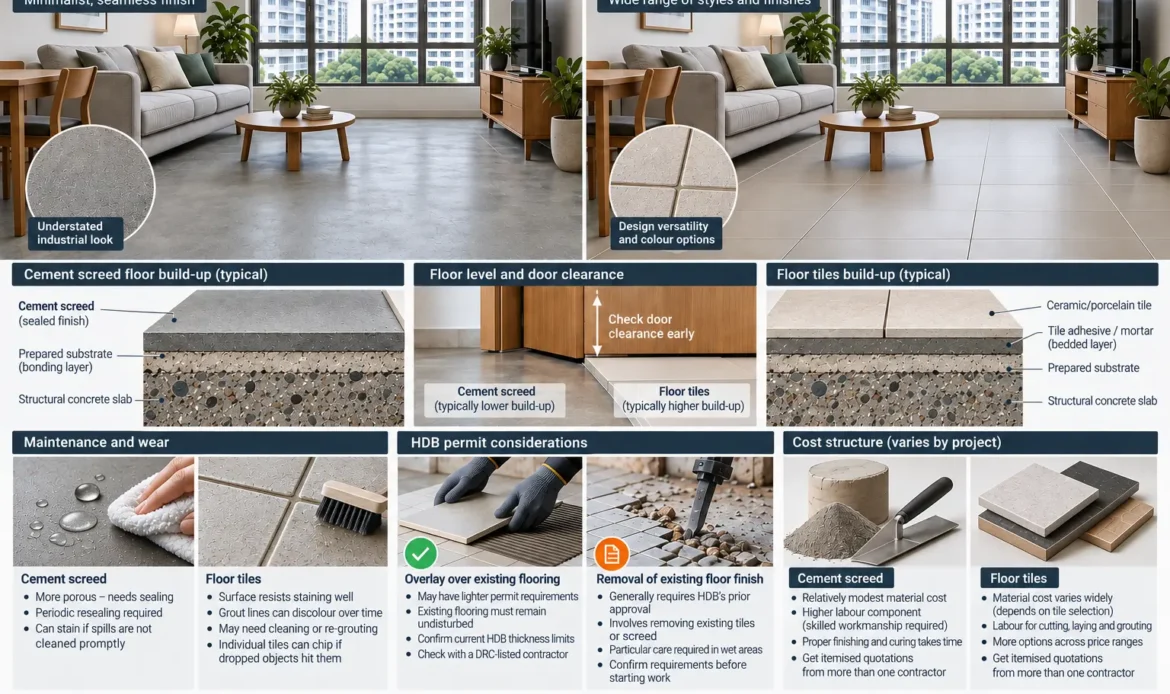
Screed and tiling draw on different cost structures rather than one being reliably cheaper. Screed’s cost is driven largely by labour, since achieving a flat, properly cured, evenly sealed surface takes skill and time, while material costs are comparatively modest. Tiling shifts more of the cost toward materials, since tile selection varies widely in price, while labour covers cutting, laying, and grouting. Because market rates shift with material availability and contractor demand, homeowners should treat any quoted price per square metre as a starting point and get itemised quotations from more than one contractor before budgeting.
Thickness and Floor Level Implications
This practical concern catches many first-time renovators: finished floor height changes depending on the option chosen, and that difference has knock-on effects throughout the flat. Tiling typically adds more build height than a screed finish applied directly over a prepared substrate, since tiles sit on a bed of adhesive or mortar in addition to their own thickness. Where different rooms use different finishes, the transition between them needs planning to avoid an awkward step. Door clearances are worth checking early too: a finish that raises the floor level by even a centimetre or two can mean doors need trimming, far easier to plan for before installation than to fix afterwards.
HDB Permit Requirements for Each Option
Whether either option triggers an HDB permit depends on a distinction covered in detail in our HDB renovation permit guide, but the short version is this: overlaying a new finish on existing, undisturbed flooring is treated differently from removing the existing floor finish first. Where a screed or tiling job involves hacking out existing tiles or floor screed, particularly in wet areas where the waterproofing membrane sits close to the surface, it generally falls under works requiring HDB’s prior approval. If applied as an overlay without disturbing the existing floor, permit requirements are typically lighter, though this depends on thickness limits HDB reviews from time to time, so confirm the current position with a DRC-listed contractor before finalising either scope.
Long-Term Maintenance and Wear
Screed and tiles age differently. An exposed screed surface is more porous than a glazed tile, so it typically needs sealing on installation and periodic resealing afterward to resist staining from liquids like oil, wine or coloured drinks. Tiles bring a different profile: the surface resists staining well, but grout lines can discolour over time and need cleaning or re-grouting, and individual tiles carry a chip risk from dropped objects that a continuous screed surface doesn’t share. Neither maintenance burden is dramatically heavier; they are simply different kinds of upkeep, and the right choice depends on how much of that upkeep a household is realistically willing to stay on top of.
Where Each Option Works Best in an HDB Flat
Living and Dining Areas
Living and dining spaces are where screed’s seamless, joint-free look tends to be most valued, reinforcing the sense of continuous space in an open-plan layout. It also tends to feel cooler and firmer underfoot than some tile options, though a hard continuous surface can carry sound differently to tiles with grout lines breaking it up, worth considering for households sensitive to footstep noise. Tiles remain a durable, low-maintenance alternative for households that prioritise resistance to daily wear over a completely seamless look.
Kitchens
Kitchens see heavier daily traffic and more exposure to grease and spills than most other rooms. If screed is used here, sealing quality becomes genuinely critical, since an inadequately sealed surface absorbs grease and stains more readily in a kitchen than almost anywhere else in the flat. Tiles handle this environment more forgivingly by default, particularly with a glazed, low-porosity finish.
Wet Areas: Bathrooms, Yards, and Balconies
Wet areas carry the highest stakes in this comparison, because the flooring sits directly above a waterproofing membrane protecting the unit below from leaks. Tiles remain the more conventional choice here, largely because their jointed, sealed installation over a waterproofing layer is a well-established system that contractors and HDB guidelines are built around. Screed is used in wet areas too, but demands even more rigorous sealing and substrate preparation given the constant moisture exposure. Newer flats may also carry restrictions on altering wet-area finishes during an initial period after handover, tied to the original waterproofing warranty, so any plan touching bathroom, yard or balcony flooring should be checked against current HDB guidelines first.
What Happens When Screed Fails in Singapore's Climate
Common Cracking and Hollowness Patterns
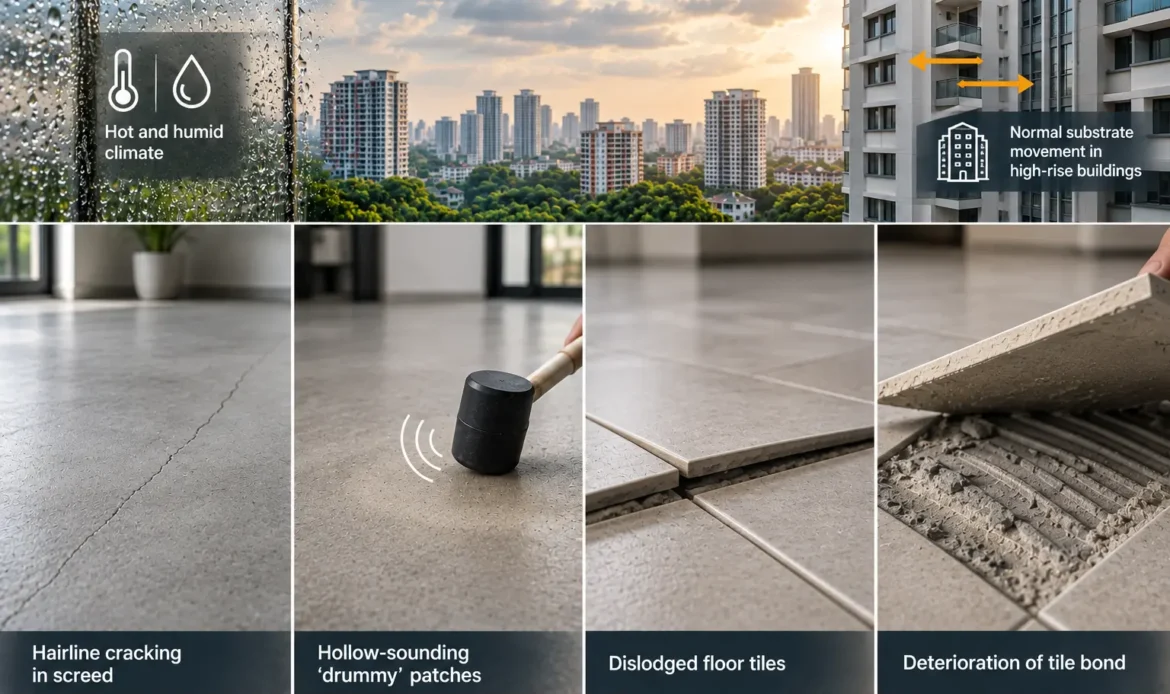
Screed failure isn’t a rare defect story reserved for renovation forums; it’s a genuine and fairly common consideration that deserves honest coverage rather than being glossed over in marketing material. Singapore’s climate plays a real role here: the country’s long-term climate data show a daily mean relative humidity in the high 70s to low 80s per cent range alongside consistently warm temperatures, and this combination, together with ordinary substrate movement in a high-rise building, can contribute to hairline cracking or hollow-sounding “drummy” patches developing in a screed floor over time.
Floor tiles are not immune to comparable issues either: HDB has noted that dislodged floor tiles are a recurring, wear-related occurrence nationwide, arising from differential thermal expansion and gradual deterioration of the bond between tile and screed rather than a single obvious cause. Neither finish should be marketed to homeowners as maintenance-free.
Prevention Through Correct Installation
Most cracking and hollowness issues trace back to installation shortcuts rather than an inherent flaw in the material. Building industry guidance on floor screed preparation emphasises proper substrate cleaning, adequate air-curing time before the surface is used or tiled over, and floor evenness checked against a defined tolerance before work proceeds, with additional reinforcement recommended for thicker applications. Skipping or rushing these steps is where a large share of long-term screed problems originate, which is exactly why who carries out the work matters as much as the material chosen.
Choosing the Right Contractor for Either Option
Why BCA Registration and HDB DRC Listing Matter for Both Finishes
Whichever finish a homeowner chooses, the quality of the outcome depends heavily on the contractor’s execution rather than the material alone. This is especially true for permit-required works, since only a contractor listed in HDB’s Directory of Renovation Contractors can submit the necessary application on the homeowner’s behalf. A BCA registration or HDB DRC listing signals a baseline of recognised standards and training, a reasonable starting point for narrowing down options, though not a substitute for checking a contractor’s own track record on the specific work in question. Leong Yik Engineering & Contractor is one example of a firm listed with HDB that carries out both cement screed and floor tiling work, illustrating the kind of registration status worth confirming when comparing quotations.
Questions to Ask Before Committing to Either Finish
A short set of direct questions to a prospective contractor tends to surface more useful information than a portfolio of finished photos. Worth asking:
- What condition is the existing substrate in, and does it need remedial work first?
- How long will the screed be left to cure, and does that fit the renovation schedule?
- What warranty, if any, covers cracking or hollowness, and what does it require of the homeowner to stay valid?
- For wet areas specifically, what waterproofing system sits beneath the chosen finish, and is it suitable for the room?
A contractor confident in their work should answer all four clearly and specifically, not with general reassurance.
Conclusion
In the cement screed vs floor tiles decision, neither option is objectively better across every HDB flat and every homeowner. Screed offers a seamless, contemporary look but demands rigorous sealing, careful curing and realistic maintenance expectations, particularly in kitchens and wet areas. Tiles remain the more forgiving, predictable option in high-moisture and high-traffic zones, at the cost of visible grout lines and their own chip risk. The right decision comes down to which rooms are involved, how much upkeep the household is prepared for, and the available budget; in nearly every case, proper installation by a properly registered contractor matters more to the long-term result than the material chosen in the first place.