

Introduction: Why the Scope Matters More Than the Price
A business owner comparing two or three MEP quotations often finds that the totals look similar while the contents differ. One quote lists every power point and test. Another summarises the same work in a few lines. The useful question is not which price is lower, but whether the scope covers the project or whether gaps will surface as extra charges mid-build. This guide shows how to read an MEP quotation for an office renovation or fit-out critically. It is an evaluation guide, not a hiring guide.
What an MEP Scope of Work Covers in an Office Renovation
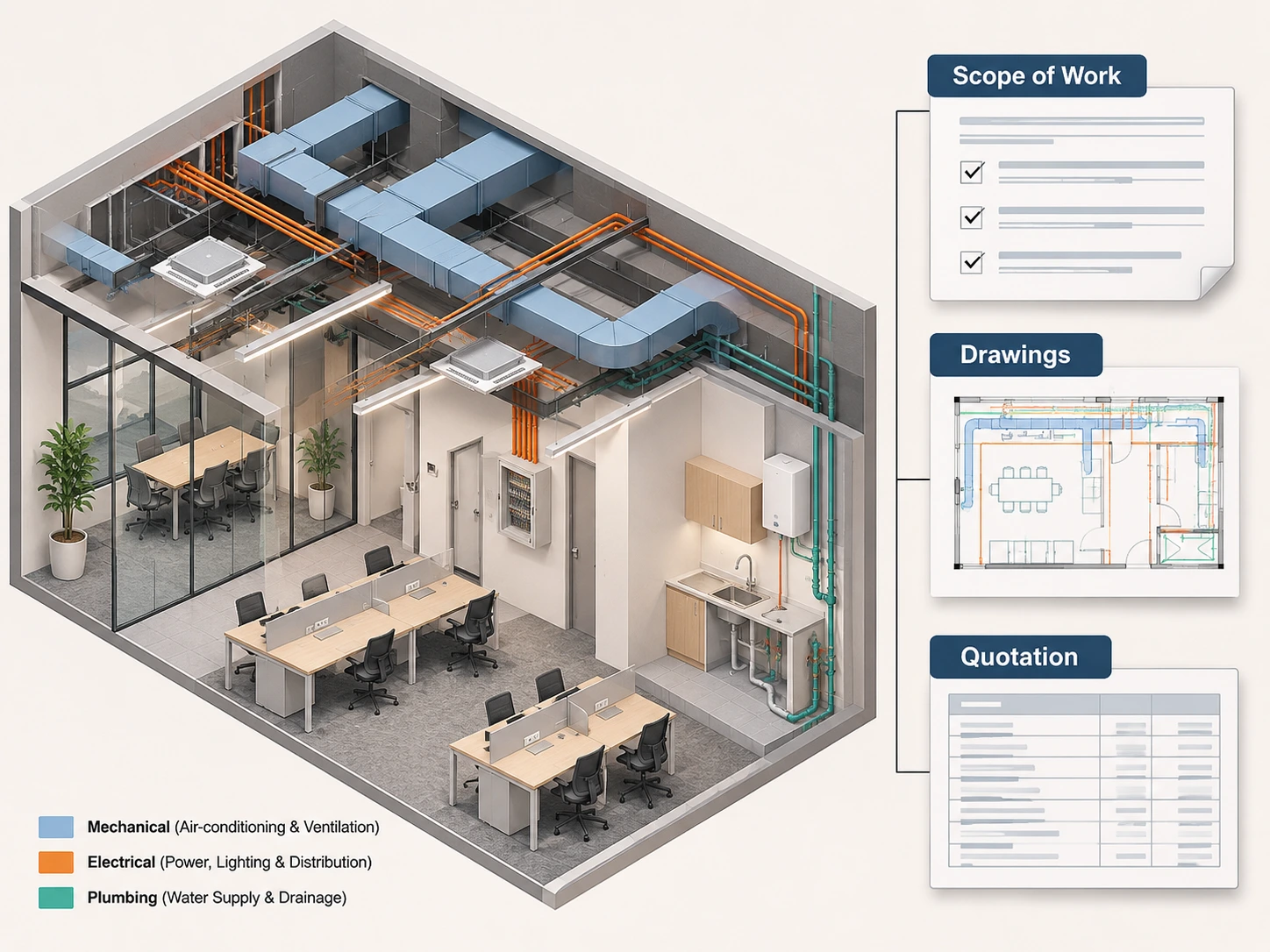
An MEP scope of work is the written statement of what the mechanical, electrical and plumbing contractor will and will not deliver. This article works through it system by system, then covers documents, testing and the areas that most often cause disagreement. If you are still deciding whether your project needs MEP coordination at all, our guide on when a renovation needs MEP coordination covers that question. This one assumes you already know it does.
Scope of Work vs Quotation vs Drawings
These three documents are often confused. The scope describes the work in words, drawings show where it goes, and the quotation prices it. Many readers treat the price sheet as the scope. A sound quotation refers back to a defined scope and a set of drawings with revision numbers, rather than standing alone. If the price sheet is the only document, there is nothing to hold the work against later.
Why Vague Scope Is the Most Common Source of Disputes
Undefined items are a frequent source of variations and disagreements because each side assumes something different. Consider a hypothetical quote that says “supply and install power points” with no quantity or type. The client expects every desk to be covered, while the contractor priced only the points shown on the drawing. Extra points are then charged separately, and neither side has done anything unreasonable. The problem is the gap in the document.
Electrical Scope
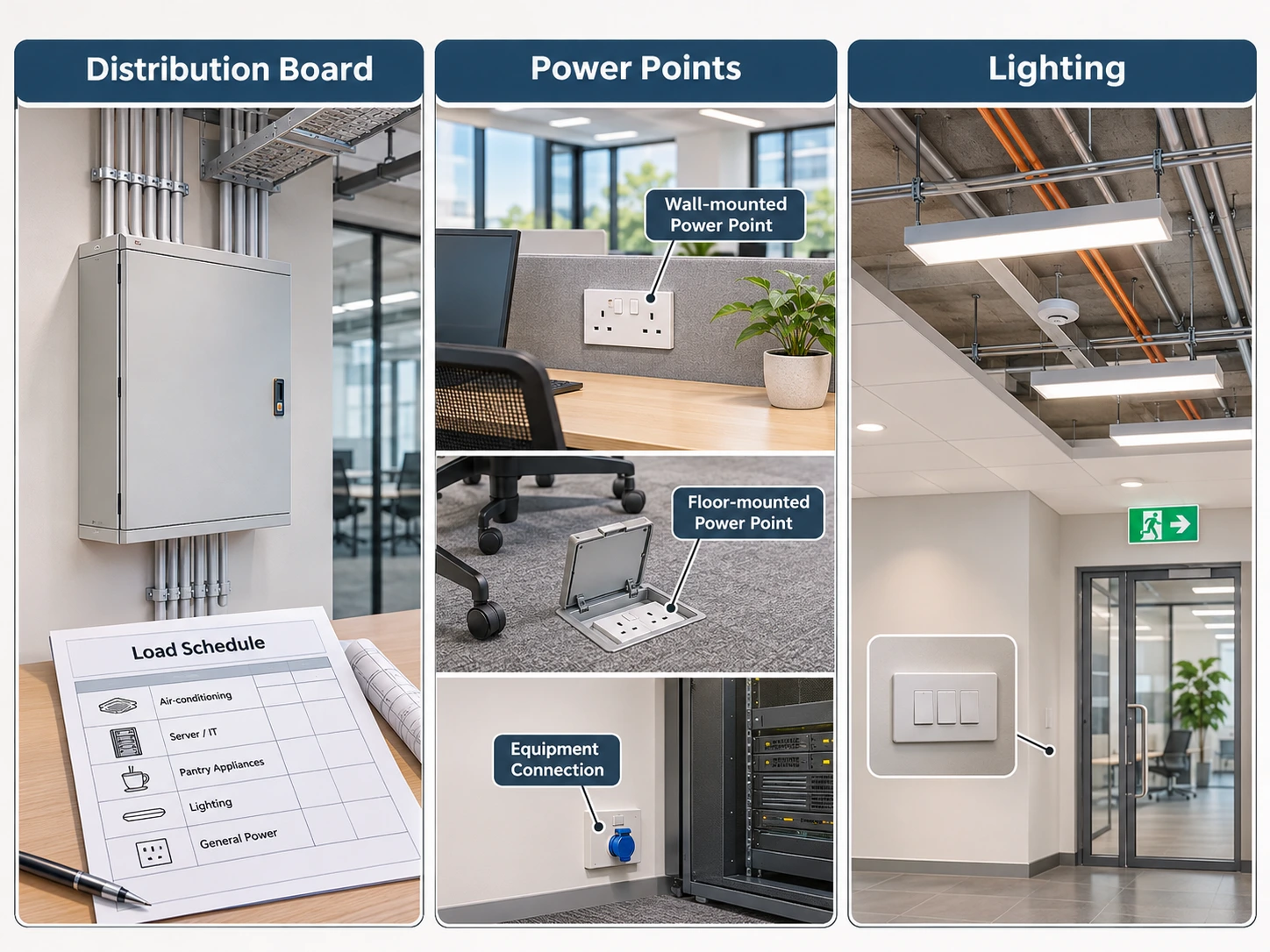
The electrical portion should be specific enough to compare line by line against other quotes.
Distribution Board and Load Requirements
The quote should state whether the distribution board is new, upgraded, or existing and retained; what load it assumes; and who confirms that the board and supply can carry the office’s demand. If equipment such as air-conditioning, server racks or pantry appliances is planned, the load assumption should reflect it.
The Energy Market Authority (EMA) advises that electrical work should be carried out or supervised by a Licensed Electrical Worker. The quote should therefore name the licensed person responsible, and who handles any approvals or inspections the work requires.
Power Points
Check quantity, type and location against the office layout. “Per point” pricing needs a defined point type, such as single or double socket, wall- or floor-mounted, dedicated or general circuit, because points are not interchangeable. Look for a stated allowance for additions, so that adding a desk later has an agreed price.
Lighting
Lighting scope should state who supplies the fittings, how circuits and switching are arranged, and how emergency and exit lighting interfaces with the work. It should also say whether lighting design is included or assumed from another consultant, since that decides who is accountable for layout and light levels.
Plumbing, Sanitary, and Drainage Scope
Pantry and washroom work is where hidden connection and making-good costs often sit, so this section deserves close reading.
Pantry and Wet Areas
Look for supply and waste routes, isolation valves, water heaters, and the interface with waterproofing and tiling. A pantry sink with no stated isolation valve, or a washroom with no stated waterproofing interface, leaves open who protects the floor once pipes are altered.
Sanitary Fittings
State who supplies each fixture: the contractor, the client or the interior designer. Then check what installation includes, such as traps, taps, connections and sealing. Supply responsibility is a frequent ambiguity, and a quote that is silent on it may assume the client provides everything.
Drainage and Connections to Existing Services
The quote should explain how new waste lines connect to existing stacks, what gradients the layout allows, and which existing conditions could change the work, such as a stack sitting in a different position from the drawings.
PUB states that regulated water service and sanitary plumbing works must be carried out by Licensed Plumbers, who are also responsible for lodging the necessary regulatory submissions. Confirm the quote names the licensed plumber and says who lodges any submission.
Interfaces With Other Trades and Specialist Systems
Some items sit at the edge of MEP scope and are easy to assume as included. Ask who is responsible for each:
- Air-conditioning and ventilation: equipment, ducting, condensate and controls
- Fire protection and alarm modifications
- Data and communications cabling
- Ceiling and partition coordination
Where work touches fire safety provisions, SCDF’s plan approval process may apply, so the quote should say who coordinates it. A simple matrix naming one responsible party per item closes most gaps.
Coordination Drawings and Documentation

Coordination drawings overlay the services to resolve clashes with ceilings, beams, and each other; fix ceiling heights; and locate access panels. A complete scope lists them as a deliverable and states when the client approves them. Expect coordination drawings before installation and as-built information at handover, so that later maintenance and alterations start from accurate records.
Testing, Commissioning, and Certification
A complete scope lists the testing for electrical and plumbing works, who witnesses it and which records are handed over. For electrical work, EMA states that the Licensed Electrical Worker will inspect and certify the installation as safe before supply is turned on. It also states that new wiring, rewiring and extensions must be tested by an authorised officer from SP Services Ltd before supply can be turned on.
A quote that is silent on testing leaves these steps unpriced. Applicable standards and certificates vary by project, so ask the contractor to name those that apply to your premises.
Making Good and Builder’s Works
Installing services means cutting, chasing and patching walls, floors and ceilings, usually followed by repainting. The gap appears when the MEP contractor assumes the main contractor will make good, the main contractor assumes the reverse, and nobody has priced it. Check whether making good sits in the MEP scope, the main contractor’s scope or no one’s, and whether it includes finishes such as paint.
Exclusions: What Quotes Commonly Leave Out
The exclusions list defines the real boundary of the scope, so read it critically. Typical categories include after-hours work, permit and submission fees, existing-condition surprises, equipment supply, requirements set by the landlord or building management, and temporary services such as power and water during construction. Not every quote omits these. The point is to check that each is either included or clearly stated as excluded.
PUB notes that it does not charge administrative fees for regulatory submissions, and that fees charged by Licensed Plumbers are commercial charges set by each plumber. Ask how submission costs are shown.
Variations: How Scope Changes Should Be Handled
A fair variation process has four parts: a written instruction, a price agreed before the work starts, approval by the person authorised to give it, and a record. Distinguish genuine changes, such as extra points requested after approval, from items implied in the original scope, such as the connection needed to make a specified fixture work. Keep each instruction and approval in writing, so that the final account can be reconciled against them. If the contract does not say how variations are handled, agree the process before signing.
Reviewing and Comparing Quotes
The table turns the sections above into a checklist you can apply to each quotation.
| Area | What to look for | What a gap looks like |
| Electrical works | Licensed worker named; scope by circuit | Contractor named, no licensed person |
| Distribution board | New, upgraded or retained; assumed load | Board mentioned with no load basis |
| Power points | Quantity, type, location; allowance for additions | “Supply and install points” with no count |
| Lighting | Fittings supplier, switching, emergency interface | A single lump-sum line |
| Plumbing | Supply and waste routes, valves, water heaters | Pantry works in one line |
| Sanitary fittings | Who supplies; what installation includes | Supply responsibility not stated |
| Drainage | Connection to stacks; existing conditions | No mention of existing stacks |
| Drawings | Coordination drawings and as-builts listed | No drawings named |
| Testing | Tests, witnessing, certificates | Testing absent |
| Making good | Named party and finishes | Silent or assumed |
| Exclusions | Each category included or excluded | Short or generic list |
| Variations | Written, priced, approved process | No process stated |
Comparing Like With Like Across Contractors
Compare scope before totals. Use the checklist to build one common list, then ask each contractor to price the same items. A lower figure may reflect a narrower scope, with items moved into exclusions, rather than better value. PUB encourages homeowners and service hirers to request itemised quotations and obtain at least three quotes when engaging Licensed Plumbers, and the same habit suits office MEP quotations. Also check that every quote assumes the same programme, working hours and site conditions, since differing assumptions change what a price includes.
Who Should Take Responsibility for MEP Within the Project
Three arrangements are common: the main contractor manages MEP, a separate specialist is appointed, or the client appoints a consultant to coordinate. Each can work. What matters is one named party accountable for coordination, clashes, licensed submissions and testing, and a clear statement of where that responsibility ends.
Leong Yik Eng and Co is one example of a contractor that includes MEP within a wider renovation scope. Our MEP services page explains how that arrangement works in practice.
Questions to Ask Before You Approve a Quote
- Is the distribution board new, upgraded or retained, and what load is assumed?
- Who is the named Licensed Electrical Worker, and who is the Licensed Plumber?
- Which coordination drawings will I receive, and when?
- What testing and certification is included, and who witnesses it?
- Who makes good after cutting and chasing?
- What is excluded, and how would each excluded item be priced if needed?
- How are variations instructed, priced and approved?
- What as-built information will I receive at handover?
Conclusion
A complete MEP scope of work for an office renovation names each system, the quantities and responsibilities behind it, the drawings and testing that support it, and the boundaries set by its exclusions and variations process. The gaps to check most carefully are exclusions, interfaces with other trades, testing and variations. If a quotation answers the questions above in writing, you can compare it with others on scope, not only on price; if it does not, ask before approving.