
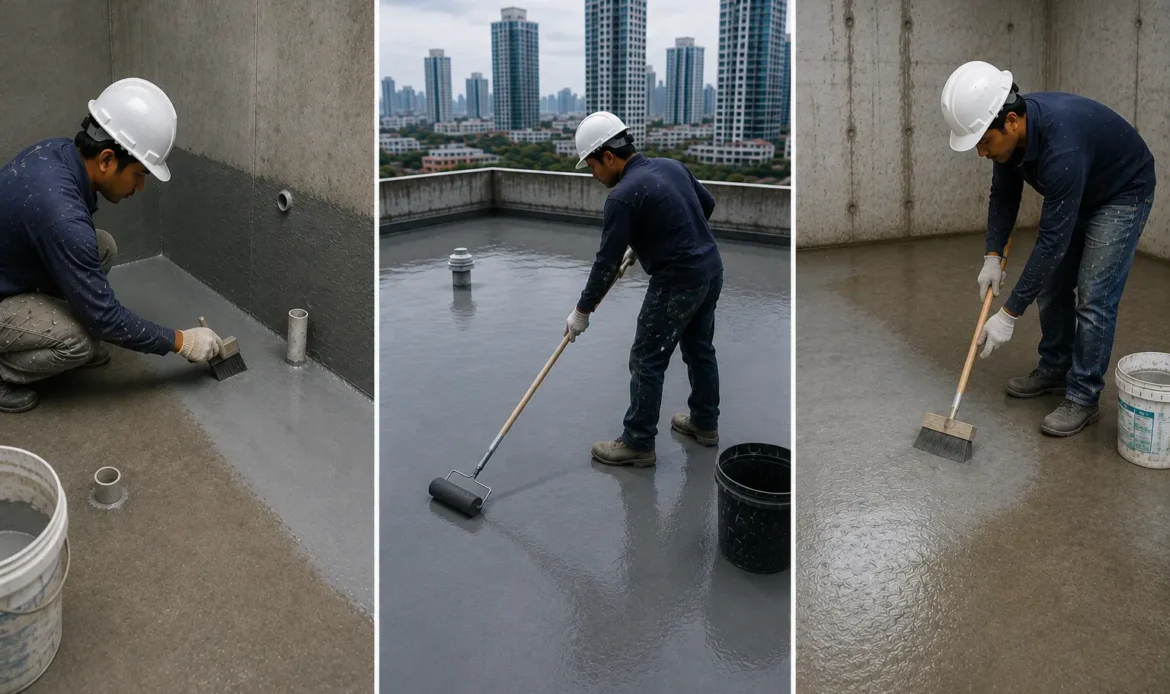
Why the Wrong Waterproofing System Means Paying Twice
The Most Expensive Waterproofing Mistake Singapore Property Owners Make
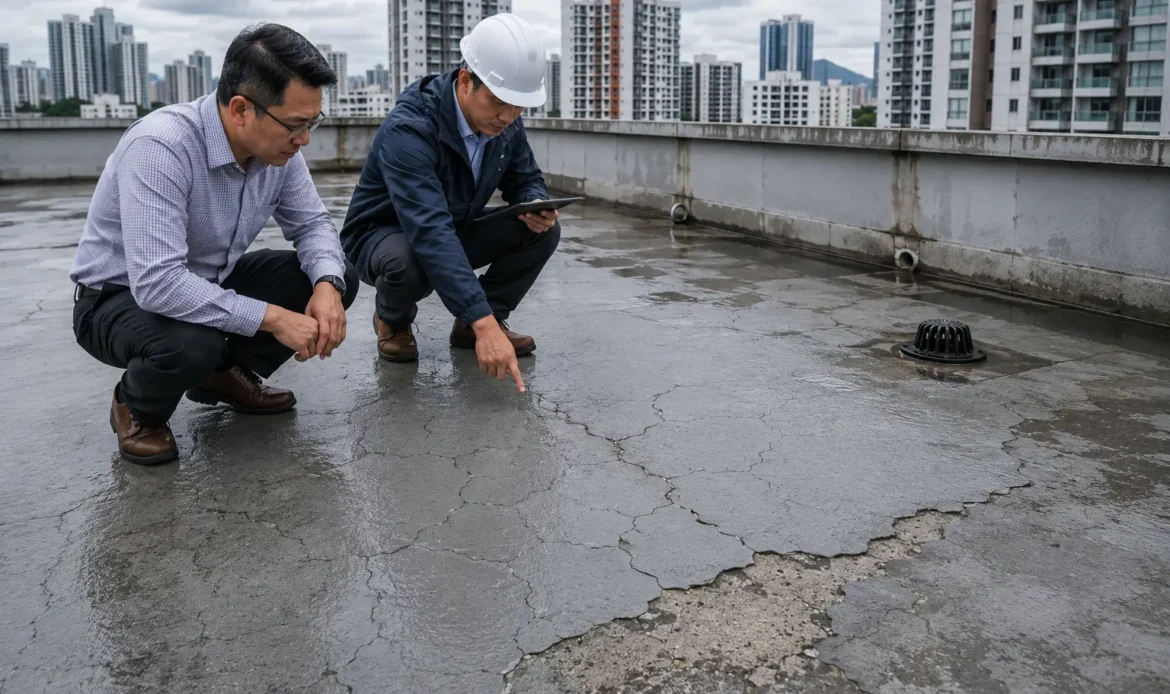
A property owner approves a cementitious waterproofing coating on a flat rooftop. Eight months later, the coating has cracked in multiple places and the stains have returned. The contractor explains that the product was applied correctly. It was. The material was simply wrong for the application. The owner pays again, this time for what should have been proposed first.
This happens because most Singapore property owners evaluate a waterproofing quote based on price and the contractor’s confidence. Without understanding why a particular product is being proposed, there is no way to evaluate whether it matches the problem and the surface.
The principle this guide establishes is that waterproofing selection is determined by surface type, movement exposure, and water-pressure direction, not by contractor preference or material cost alone.
Why Singapore's Climate Creates Specific Selection Requirements
Singapore’s day-night temperature differential causes concrete to expand and contract continuously throughout the year. Rigid waterproofing products cannot accommodate this movement without cracking. Singapore’s UV index regularly reaches 12 to 14, one of the highest ranges globally, degrading certain membrane materials significantly faster than temperate-climate product testing reflects. Monsoon rainfall creates sustained hydrostatic pressure on flat rooftops and basement walls. And whether treatment is applied on the same side as the water source (positive side) or the opposite side (negative side) determines which products are viable at all.
The Three Main Waterproofing Systems Used in Singapore
What Each System Is and How It Works
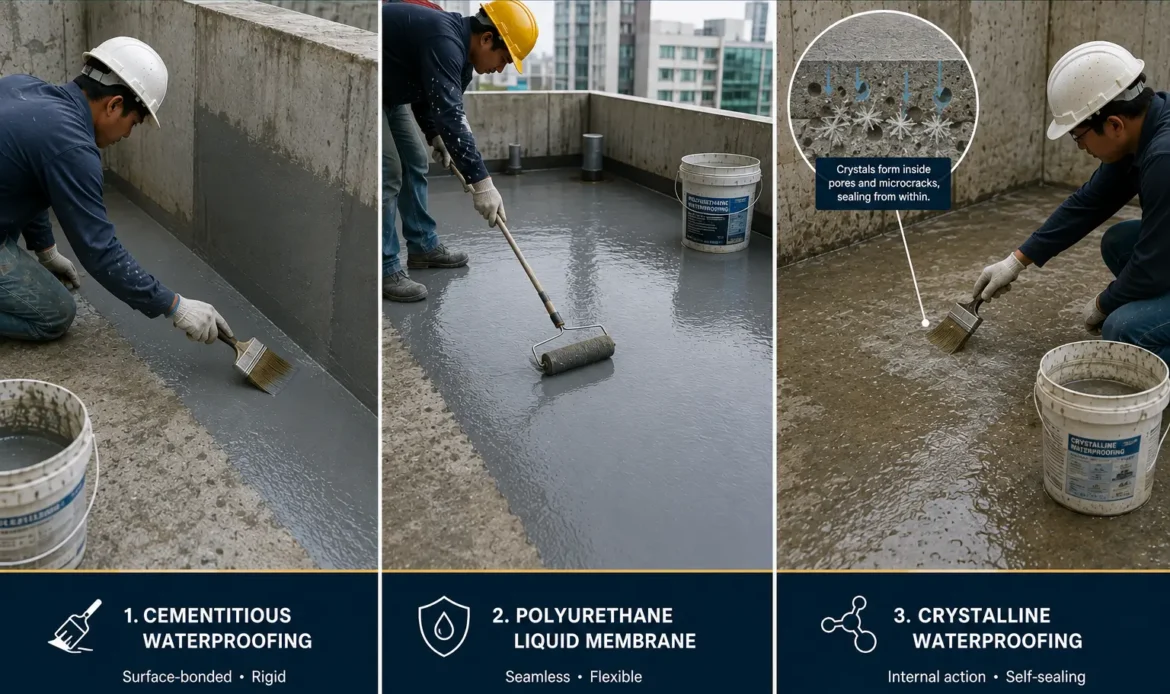
Cementitious Waterproofing: What It Is and How It Creates a Water Barrier
Cementitious waterproofing is a cement-based compound applied as a slurry or brush-on coating that bonds to the concrete substrate and fills surface pores and capillaries. It does not form a membrane above the surface but becomes part of it. Two-component products (cement powder mixed with a liquid polymer) offer greater flexibility than single-component formulations mixed with water only. The critical limitation is rigidity: it cracks if the substrate cracks or shifts beneath it.
Polyurethane Liquid Membrane: What It Is and How It Creates a Water Barrier
Where cementitious products bond to the concrete, the polyurethane liquid membrane cures into a seamless, rubber-like coating over the substrate. It bridges small cracks and flexes as the surface beneath it moves. Two-component formulations cure more predictably in Singapore’s variable humidity than single-component moisture-cured products. The critical limitation is substrate condition: the membrane debonds at damaged areas if applied over severely cracked or deteriorated surfaces without repair.
Crystalline Waterproofing: What It Is and How It Creates a Water Barrier
Unlike cementitious and polyurethane products, crystalline waterproofing does not form a surface layer. Instead, it contains active chemicals that migrate into damp concrete and react with cement particles to form insoluble crystals within the matrix, filling capillaries and microcracks from inside. The crystals remain dormant and reactivate when water is present again, making it self-sealing throughout the concrete’s life. The critical limitation is substrate specificity: it requires intact concrete and does not work over paint, coatings, loose screed, or non-concrete surfaces.
Which System for Which Surface: The Application Match That Determines Success
Flat Rooftops and Exposed Roof Decks
Polyurethane liquid membrane is the appropriate primary treatment for flat rooftops in Singapore. Its elasticity accommodates the thermal expansion and contraction Singapore’s climate imposes on flat concrete slabs. Cementitious coating fails on exposed rooftops because it cannot accommodate this movement: cracking within one to two monsoon seasons is the predictable outcome, not a defective product. BCA-registered contractors typically specify a minimum dry film thickness of 1.5mm to 2.0mm with a primer and flood test protocol before handover.
Bathrooms, Wet Areas, and Balconies
Bathrooms and wet areas are applications where cementitious two-component products genuinely excel. Interior surfaces subject to intermittent water exposure without structural movement or UV exposure are the ideal condition for cementitious materials. The treatment must extend up the wall to a minimum height above finished floor level: a coating covering only the floor slab will fail at the wall-floor junction where movement is highest. Balconies exposed to UV or areas with documented movement history may warrant polyurethane membrane instead.
Concrete Water Tanks, Reservoirs, and Basement Walls
Crystalline waterproofing is the technically appropriate treatment for concrete water tanks because it holds potable water certification, unlike most polyurethane membranes. Crystalline products satisfy PUB’s water quality requirements for storage tanks supplying drinking water. For basement walls where access is limited to the interior (negative side), neither polyurethane nor cementitious coating is reliable under negative water pressure. Crystalline waterproofing is specifically designed for this condition, migrating toward the water source rather than being pushed off the substrate by it. Where exterior access is available before backfilling, polyurethane membrane is the preferred positive-side treatment for basement walls.
Car Park Decks and Podium Slabs
A standard rooftop polyurethane membrane will fail on a car park deck within months. The deck requires a traffic-bearing specification that includes a wear-resistant top coat rated for vehicular loads, abrasion, and exposure to vehicle fluids. Cementitious products fail on car park decks due to a combination of rigid cracking, vehicular loads, and shrinkage cracking typical in large concrete slab areas.
Retaining Walls, Planters, and External Below-Grade Structures
For accessible structures, applying a positive-side polyurethane membrane before backfilling, with a protective board to prevent membrane damage during filling, is the standard approach. For structures already in service where only the interior face is accessible, crystalline waterproofing from the negative side is the appropriate method. Where the wall is inaccessible on both sides with active leaks, injection grouting is used to stop active water before any surface treatment is applied.
Side-by-Side Comparison: How the Three Systems Differ Across the Factors That Matter
Service Life, Flexibility, Application Conditions, and Cost in Singapore's Market
Factor | Cementitious | Polyurethane Membrane | Crystalline |
Flexibility under movement | Rigid; cracks under structural or thermal movement | Elastic; accommodates continuous movement | Rigid; requires stable intact concrete |
Exposed UV applications | Not suitable | Suitable with UV-stable formulations | Not suitable as sole treatment |
Potable water contact | Not certified | Most products not certified | Certified options available |
Negative-side application | Unreliable under pressure | Not suitable | Designed for this condition |
Application to damp substrate | Required (surface must be damp) | Not suitable (requires dry substrate) | Required (active chemicals need moisture) |
Application over active leaks | Not suitable (hydraulic cement stops first) | Not suitable | Possible with rapid-set plug compounds |
Typical service life in Singapore | 15 to 25 years (interior wet areas) | 10 to 15 years (exposed rooftop) | Indefinite in stable concrete |
Primary applications | Bathrooms, wet areas, tank interiors | Rooftops, car park decks, positive-side basements | Water tanks, negative-side basements, retaining walls |
How Long Each System Lasts Under Singapore's Conditions
Polyurethane membrane on exposed rooftops lasts 10 to 15 years for standard formulations; high-performance UV-stable versions can extend to 20 years with maintenance. Cementitious coating in interior wet areas without movement lasts 15 to 25 years; service life drops sharply where thermal movement occurs. Crystalline waterproofing has no finite service life in stable concrete because the crystals persist and reactivate in the presence of water throughout the concrete’s life.
Which System Allows Application Over Active Water Leaks
Only crystalline waterproofing can be reliably applied while water is actively leaking, using rapid-set crystalline plug compounds to control flow before full surface treatment. Polyurethane membrane cannot be applied over wet or damp substrates; the surface must have a moisture content below a specified maximum. Cementitious coating can be applied to damp surfaces but not over active flow; minor seepage requires hydraulic cement stops first.
The Decision Framework: How to Match System to Problem in Singapore
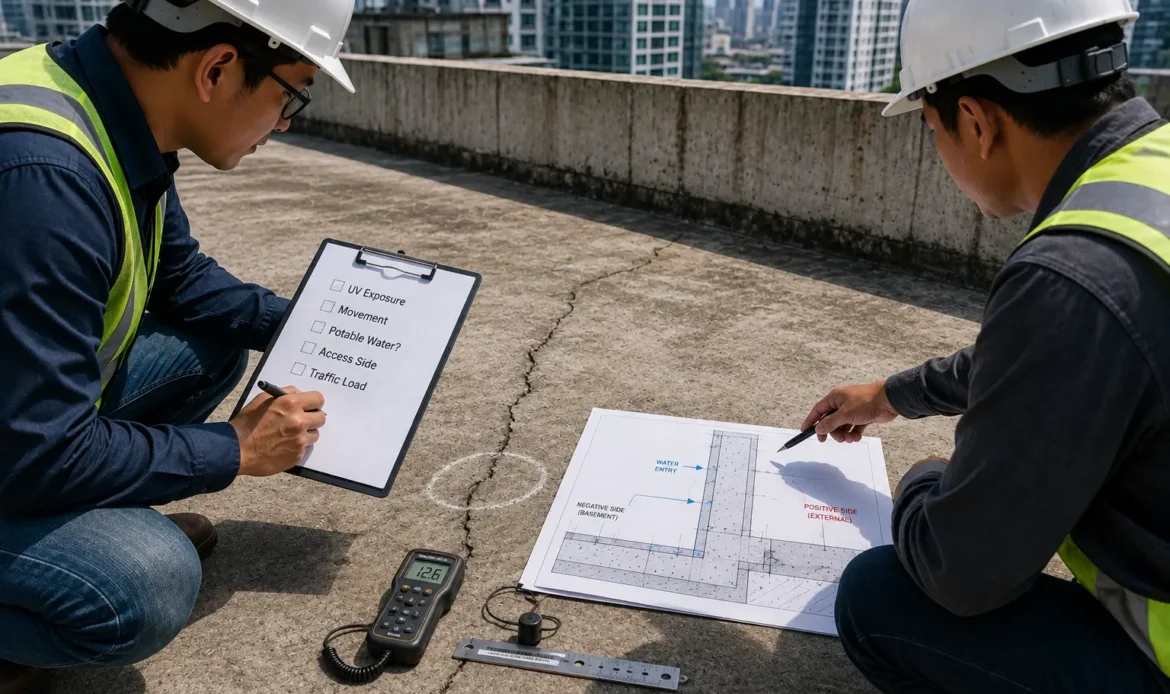
A Practical Checklist for Evaluating a Waterproofing Recommendation
Five questions establish whether the proposed approach is correct before any work begins.
1. Is the surface exposed to UV?
Cementitious products are not appropriate as the sole treatment for exterior horizontal surfaces.
2. Is the surface subject to structural or thermal movement?
If yes, a flexible polyurethane product is required; rigid materials will crack.
3. Does the surface contact potable water?
Crystalline products with potable water certification are required; most polyurethane membranes are not certified.
4. Is access limited to the negative side only?
Only crystalline or injection grouting is reliable under negative pressure.
5. Is the surface a traffic-bearing deck?
A traffic-bearing polyurethane specification with wearing course is required; standard rooftop membranes are not rated for vehicular loads, abrasion, or chemical exposure from vehicle fluids.
What to Do If the System Proposed Does Not Match the Checklist
Ask the contractor to explain how the proposed product matches the surface type, movement conditions, and water pressure direction. A competent waterproofing contractor should answer without hesitation. A contractor proposing the same product for every application regardless of surface type is either working outside their expertise or proposing what is most convenient to apply. Request a written specification including product name, manufacturer, application method, minimum coverage rate, dry film thickness, and curing protocol. All of these should appear in the quote before work begins.
How BCA-Registered Waterproofing Contractors Approach System Selection in Singapore
Leong Yik Eng & Co Pte Ltd is a BCA-registered waterproofing contractor in Singapore whose approach to selection begins with an on-site assessment of the surface type, failure mode, water-pressure direction, and movement history before specifying the appropriate product for the situation.
Conclusion
There is no universal waterproofing product appropriate for every situation. Cementitious coating suits interior wet areas without movement. Polyurethane liquid membrane suits exposed rooftops, car park decks, and any surface subject to thermal or structural movement. Crystalline waterproofing suits concrete water tanks with potable water contact requirements, negative-side basement walls, and situations where the treatment must self-seal within the concrete matrix. Singapore’s thermal cycling eliminates rigid products from exposed rooftop applications. Negative-side access requirements drive crystalline specification for inaccessible basement and retaining structures. Five questions about UV exposure, movement, potable water contact, access side, and traffic loading identify the correct product before a contractor is engaged. A contractor who cannot explain why what is being proposed matches those conditions should not be trusted to specify the right one.